Emiliano Bellini

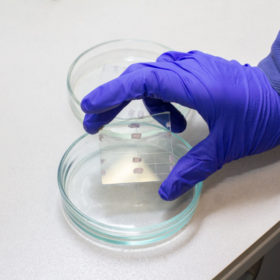
Russian scientists achieve 21.1% efficiency in perovskite solar cell via Mie-resonant silicon nanoparticles
A Russian-Italian research group has developed resonant silicon nanoparticles that are claimed to improve the performance of perovskite solar cells. These particles serve as nanoantennae – they catch light and it resonates inside them, which amplifies the cell’s light absorption.
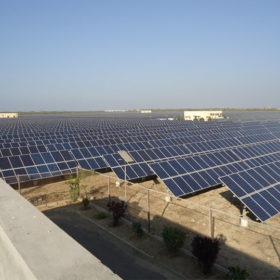
TataPower wins 250 MW tender in India with bid of $0.033/kWh
With this large-scale solar project, the company’s total renewable capacity will swell to 4,611 MW, comprising an installed capacity of 2,947 MW and 1,664 MW under implementation.
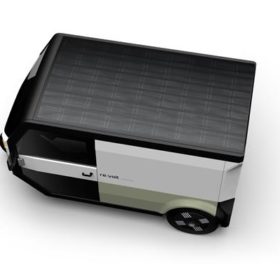
Solar-powered delivery van with 400 km range
Swedish start-up Clean Motion is seeking to commercialize an electric delivery van that is also powered by IBC solar modules placed on its roof. The vehicle is claimed to have a 400 km range, of which up to 130 km are provided by the PV array.

Pakistan wants to build solar plants on canals
Pakistan’s Punjab region is planning to build solar plants on top of canals across several locations. Experts are now being sought to conduct a feasibility study and identify potential locations.
‘High energy prices are more of a threat than an opportunity for renewables’
In a short interview with pv magazine, Indra Overland, head of the Center for Energy Research at the Norwegian Institute for International Affairs, explains how keeping a cap on gas and electricity prices is crucial to avoid long-term political damage and a loss of support for decarbonization plans. While it is difficult to say what the overall impact on the world economy will be, high costs and instability are rarely beneficial for economic growth, he says.
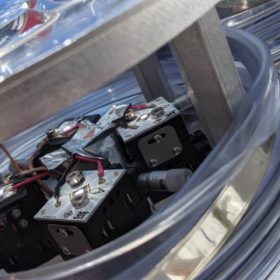
CPV module with improved short-circuit current via microstructured encapsulant coatings
A Canadian consortium led by the Sherbrooke University has developed a CPV panel with improved light absorption through a microstructured anti-reflecting coating consisting of a monolayer of silica beads, which they claim can improve the device’s short-circuit current by up to 3.7%. The module is based on III-V solar cells.

Electricity taxes, levies preventing heat pump market growing in Europe
A new report from the European Heat Pump Association (EHPA) has shown that heat pump technologies are currently unable to compete for heating with gas due to high taxes and levies on electricity. According to its experts, a carbon tax, or removing this tax imbalance, may create a level playing field for renewable technologies in the heating sector.
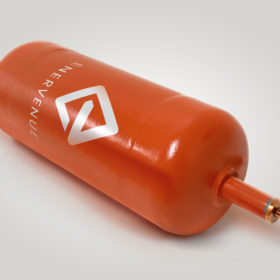
Nickel-hydrogen battery for large scale renewables
U.S. start-up EnerVenue has secured funding to build a gigafactory to produce nickel-hydrogen batteries for large scale renewable and storage applications. The battery has an efficiency ranging from 80 to 90%, depending on the cycle rate, and its energy density per square foot is equal to, or better than lithium-ion batteries, according to the company.
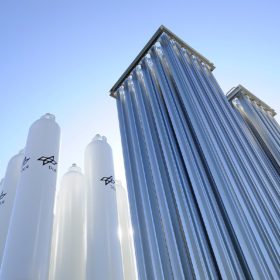
PV-generated hydrogen cost projected to drop to €0.7 and €1.8/kg by 2030
Green hydrogen cost may reach between €0.7 and €1.8/kg by 2030 and €0.3 and €0.9/kg by 2050, according to a European research team led by the European Technology and Innovation Platform for Photovoltaics. The scientists found that the levelized cost of hydrogen (LCOH) could drop from around €0.031-0.081/kWh currently to €0.02-0.05 by 2030 and €0.01-0.027 by 2050.
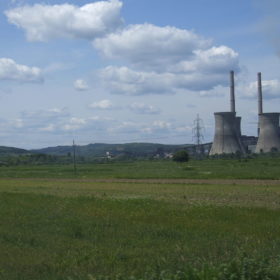
Romanian coal provider has 725 MW of PV under development
CE Oltenia wants to build eight solar parks at three of its coal power plants and five of its coal mining sites by 2026. This new capacity should replace installed power from coal that the company wants to shut down over the next five years.
