Emiliano Bellini

Mathematical model to couple PV, wind with cooling-heating-power systems
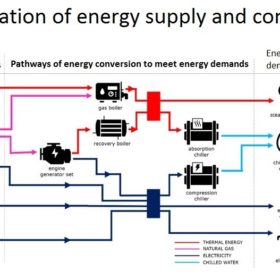
Brazilian researchers have proposed a new mathematical model to change parameters for wind and solar resources and different levels of energy demand. The model was originally conceived for tropical regions, but it can actually be used in any location. The new methodology models a highly complex system featuring wind turbines and PV modules, as well as solar collectors, fuel lines, gas boilers, engine-generator sets, recovery boilers, absorption and compression chillers, and grid electricity.
Solar facade with frameless design
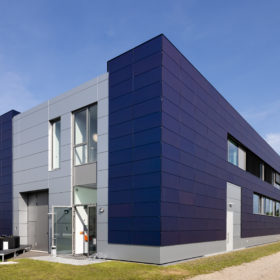
The frameless design of the 50 kW facade was made possible by a concealed suspension technology that, according to its creators, eliminates the need for additional edging at the edge of the module. The installation was built with 135 W CIGS solar modules.
What seawater and salt spray can do to a PV system
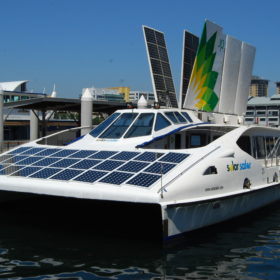
Researchers in China have analyzed how the marine environment influences the performance of PV modules deployed on ships, and have found that salt particles can be detrimental to their performance as these act as both heating agents and a factor reducing solar irradiance. The temporary cooling effect provided by seawater is not sufficient to offset the impacts of salt spray and ensure increased power yields.

Rising gas, electricity prices create new opportunities for short-term PPAs in Europe
Higher gas and electricity prices could open up new opportunities for short-term power purchase agreements in the Italian and European renewable energy markets, according to Stefano Cavriani, the founder and director of EGO Energy, an Italian company that specializes in PPA hedging. In a chat with pv magazine, he explained that electricity prices should not increase more, but they may stabilize at current levels, or slightly below the €100/MWh threshold.
Bangladeshi steelmaker launches tender for 10 MW PV project
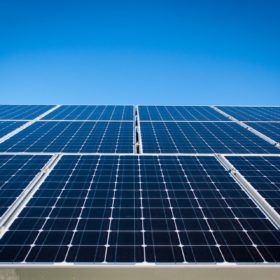
GPH Ispat will build a solar plant on an artificial lake that is used to harvest rainwater, with panels to also be deployed on lakeside hills and the rooftops of the company’s main factory and offices.
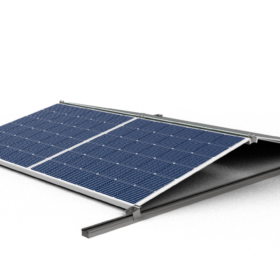
Solar module for east-west installations on flat rooftops
Dutch startup Solarge has developed a 500 W panel that weighs 50% less than conventional glass-backsheet modules. The new product can be fixed to rooftops with roofing anchors, which eliminates the need for ballast, according to the manufacturer.
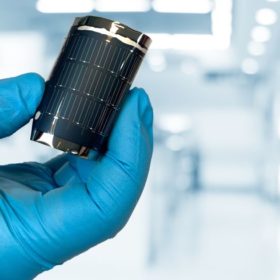
Swiss scientists achieve 21.4% efficiency for flexible CIGS solar cell
The result was confirmed by Germany’s Fraunhofer Institute for Solar Energy Systems (Fraunhofer ISE). The cell was fabricated through a low-temperature co-evaporation method for the growth of the light-absorbing CIGS semiconductor thin film.
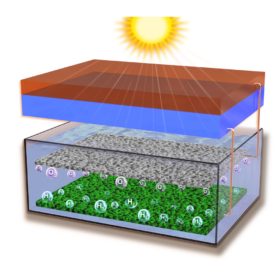
Direct solar hydrogen generation tech powered by 24.3%-efficient tandem perovskite-silicon solar cell
Developed by Australian scientists, the demonstrated system is claimed to achieve a solar-to-hydrogen efficiency of 20% at a levelized cost of hydrogen (LCOH) of $4.10/kg. The direct solar hydrogen generation technology is powered by a tandem perovskite-silicon solar cell with an unprecedented high open-circuit voltage of 1.271 V, and a power conversion efficiency of 24.3%.
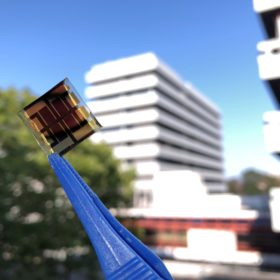
Co-evaporated perovskite solar cell with 19.5% efficiency
German scientists have built a perovskite solar cell with spiro-TTB as a hole transport material, via the thermal co-evaporation method. The solar cell has an open-circuit voltage of 1.08 V, a fill factor of 83.0%, and a short-circuit current of 21.6 mA cm.
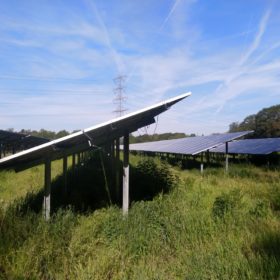
Minimum solar panel raw distance crucial for good soil, vegetation conditions, in solar parks
A Dutch research group has shown that south-oriented solar parks offer better environmental conditions for soil and vegetation than east-west oriented facilities. According to their findings, a distance between panel rows of at least 1.5 times panel height is crucial to favor ideal plant growth and soil functioning.
