Emiliano Bellini

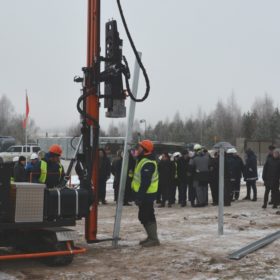
109 MW Belarus PV project commences construction, located on site irradiated in Chernobyl nuclear disaster
Belarusian civil engineering company ZAO Belzarubezhstroy has been awarded the contract to build a 109 MW PV power plant in in the Cherikov District of the Mogilev Region. The company reports that ground works for the projects have already commenced on land that was effected by radiation a result of the 1986 Chernobyl nuclear disaster.

Sipchen begins production of EVA films at 4,000 MT factory
The Saudi oil company has started manufacturing activities at its $40 million facility in the Hail Industrial City. The factory is being run by the group’s unit, Saudi Specialized Products Company (SSPC).

Saudi Arabia plans new long-term RE targets, will resume tenders
Although the Saudi authorities were expected to launch tenders for 3.3 GW of solar last year, these were postponed. According to local industry sources, when new targets for renewables are set and more clarity on solar capacity expansion provided, the first tenders will be issued. The new targets are expected to also include the ambitious 200 GW project announced by the Saudi Government last March.
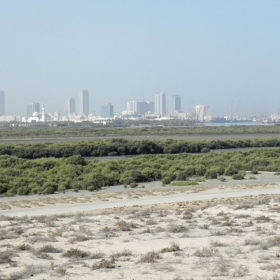
UAE: 200 MW solar park under development in emirate of Umm Al Quwain
With Dubai and Abu Dhabi having already implemented big plans for solar energy development, the small northern emirate of Umm Al Quwain has now announced its first large-scale solar power project.
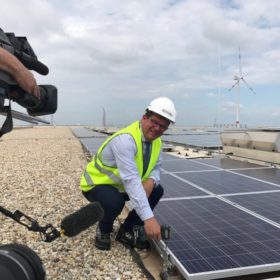
Belgium: Flemish government supports floating PV to the tune of €4.1 million
After providing €2 million for two projects in October, the government of Flanders has now selected six more floating PV projects totaling 11.1 MW, which are planned to be built with public support.
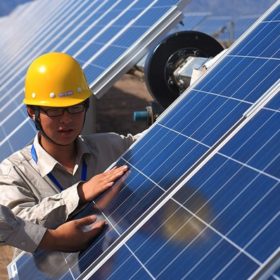
GCL-Poly plans to sell wafer unit, expects $77.6 million loss for first 10 months of 2018
After the failed attempt to sell a majoritry stake in its main polysilicon unit, Jiangsu Zhongneng, the Chinese solar manufacturer has now agreed to sell its wafer unit Suzhou Kezhun to Huajun Holding Group for US$123.6 million. The operation is part of the company’s plan to focus on wafer manufacturing based on the diamond-wire sawing technology and shift production to low-cost locations.

Colombia launches first RE auction
Through the long-awaited auction, which will be held on February 26, the Colombian Government intends to allocate 1.18 million MWh per year. Selected projects will be awarded a 12-year PPA.

EnerGaïa: Solar will be main pillar of France’s energy transition
The French renewable energy fair confirmed the central role of solar in the country’s energy transition. Despite the current difficult political situation, the event attracted more visitor and exhibitor numbers than ever. Read on to discover the four key takeaways from this year’s EnerGaïa.
Wind, solar could be self-financing by 2025 under current European electricity market design
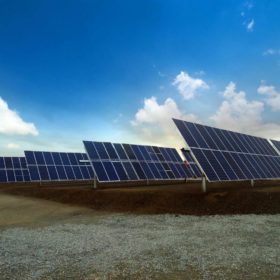
According to a report from the Centre on Regulation in Europe (CERRE), lower capital costs for large-scale wind and solar projects, and much higher fossil fuel and carbon prices could lead to renewables becoming self financing by 2025. If these conditions do not materialize, more auctions and tenders may still be needed.
Turkey hits 5 GW of registered PV capacity
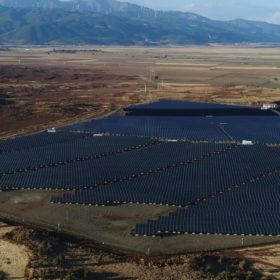
A total of 1.58 GW of new PV systems have been registered with Turkey’s grid administrator in 2018. Of this new capacity, 1.51 GW is in the unlicensed project segment, for arrays up to 1 MW in capacity, while the remaining 63 MW is for larger projects that had been successful in bidding for PEKA auctions.
