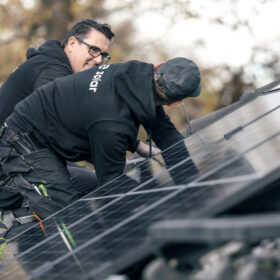
German PV system prices down by over 4% since November
The Selfmade Energy online platform says that prices for PV systems and battery storage systems fell by more than 4% between November 2023 and March 2024. In March, for example, 6 kW PV systems without batteries were sold for between €1.66 ($1.79)/W and €2.10/W.
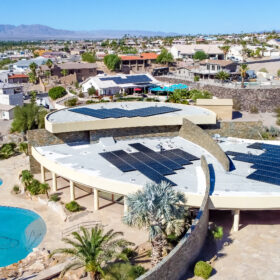
‘We must push back on net billing’
With California’s NEM 3.0 legislation having gutted panel sales and Arizona heading a bevy of other US states preparing to reduce solar-export payments, it’s time the United States solar industry stepped up, for ourselves as well as our customers.
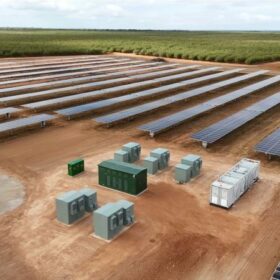
Australian utility delivers PV-powered microgrid for farm operation
AGL Energy has completed the installation of a solar-powered microgrid with a 5.4 MWh battery energy storage system in Australia to support the transition of a commercial orchard’s operations from diesel to renewables.

Standalone PV-plus-storage system for EV recharging
Indian scientists have designed an off-grid power system that relies on solar panels, lithium-ion batteries and Ćuk converters. The converters are the crucial components that enable the system to deal with varying input voltage due to changing sunlight conditions.
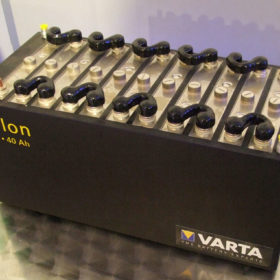
Sinovoltaics publishes energy storage manufacturer financial stability ranking
Sinovoltaics has released its latest energy storage manufacturers ranking report, based on balance sheet assessments and publicly available financial information. It lists US-based Tesla as number one, followed by South Korean’s LG Energy Solution, Taiwan-based Kung Long Battery, China’s Mustang Battery, along with US-based Solid Power in the top five.
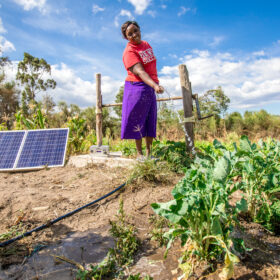
Payment plans key for solar water pumping in Sub-Saharan Africa
If solar-powered irrigation pumps can be rolled out in a responsible manner at scale, the impact on agriculture in sub-Saharan Africa could be transformational.
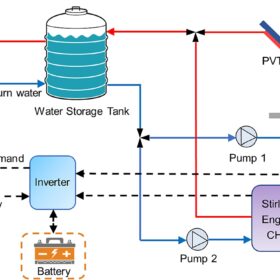
Powering homes with PVT energy, Stirling engines, battery storage
UK scientists have proposed a way to combine photovoltaic-thermal energy with Stirling engines and battery storage in residential buildings. Despite the high upfront costs, they said the cost-effective hybrid co-generation system could significantly reduce CO2 emissions.

Buildings can offer gigawatts of new peak capacity as ‘batteries’
Modeling shows that shifting just one-third of the electricity consumption of commercial and institutional buildings in Australia to the middle of the day, coinciding with peak solar supply, would create almost 12 GW of new peak capacity in the National Electricity Market.

Solar-hydrogen solution rolled out for off-grid settings
A new mobile power generator that combines solar and renewable hydrogen to provide zero-emissions power for remote and off-grid applications has been unveiled by Australian startup H2PowerBox.
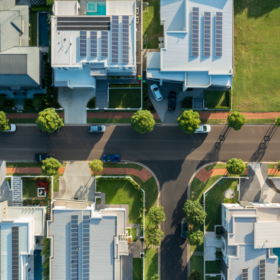
South Australia tests energy-smart homes to ease pressure on grid
An “Australian first” demonstration of aggregated flexible demand in residential settings will be rolled out in South Australia, with the state’s principle electricity distributor to deliver smart energy upgrades for 500 households as part of a pilot program to coordinate power usage and support the grid.
