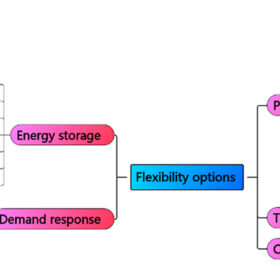
Flexibility options are a central concept for highly renewable energy systems research
To address the variability of renewable energy for a stable supply, 22 distinct types of flexibility options are found in 100% renewable energy systems research articles, categorized into power-to-X, energy storage, demand response, transmission and distribution grids, and curtailment.
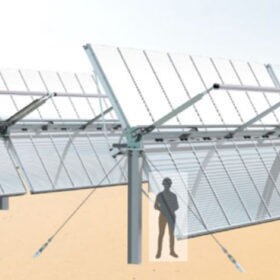
Concentrated solar plant turns to plastic mirrors to power clean heat
South Australia researchers will team with industry partners to build a concentrated solar thermal plant in New South Wales featuring lightweight plastic mirrors that incorporate an aluminium-silica reflective coating to produce industrial heat or electricity.
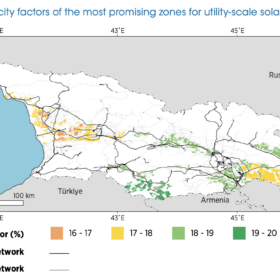
Georgia could host up to 87 GW of solar
The International Renewable Energy Agency (IRENA) says Georgia holds vast potential for solar, with most prime sites for deployment concentrated in the country’s east, based on a recent zoning assessment.

Falling prices, rising geopolitical risks define energy storage scenarios
Experts speaking at the upcoming NetZero Milan Expo-Summit 2025 have told pv magazine that lithium’s rising competitiveness is pressuring emerging chemistries like sodium-ion, as the market shifts from incremental gains to larger cells that could reshape enclosure design.

pv magazine Focus: As storage scales, co-located solar projects must adapt
At pv magazine’s Focus event at Intersolar Europe this week, moderated by ESS News Editor Marija Maisch, the panelists discussed co-location and financing, alongside forward-looking presentations on market trends.
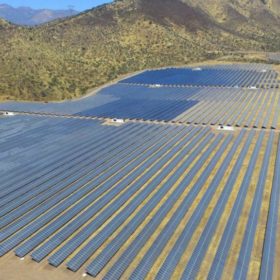
Brazil to add 19.2 GW of solar capacity in 2025
The additions represent marginal growth compared to 2024, according to SolarPower Europe. Last year, the country ranked second in new installations, behind only India (30.7 GW), the United States (50 GW) and China (329 GW). In terms of cumulative capacity through December 2024, the country ranked sixth, with 66.7 GW.
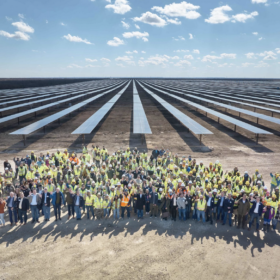
Watershed moment for Texas solar
As Texas suddenly finds itself a leader in both solar deployment and manufacturing, debate in the state legislature and US Congress could shape how much the Lone Star State once again will shape the nation’s energy trajectory.

The Hydrogen Stream: Sungrow starts world’s largest dual-tech green H2 plant
Sungrow Hydrogen has started production at China’s largest dual-tech green hydrogen project combining PEM and alkaline electrolyzers, while HNO International has partnered with Zhuhai Topower to pilot its modular hydrogen platform in China.

Ohio Supreme Court rejects local opposition to block 325 MW solar project
Despite Ohio’s intensified local opposition and restrictive solar restrictions in recent years, the state’s Supreme Court sided with the Ohio Power Siting board to allow a 350 MW project in central Ohio.

‘Blaming renewables for Spain’s blackout is like faulting the thermometer for the fever’
The recent blackout in the Iberian grid should not be interpreted as failure of renewables. But it did provide Europe with a sign the energy system is changing, shedding light on the necessity to govern 21st-century technologies with 21st-century control systems.
