
Pushing perovskite solar cells to the ultimate thickness limit
Researchers in Singapore have developed fully vacuum-processed ultrathin perovskite solar cells with absorber layers as thin as 10 nm, achieving high transparency and stable efficiencies up to 12%. These cells balance optical transparency and electrical performance, offering scalable, design-flexible photovoltaics suitable for seamless integration into buildings.

Tongwei moves into hybrid heterojunction back contact solar cell technology
Tongwei is partnering with GS-Solar and Golden Solar to develop a large-scale manufacturing facility for hybrid heterojunction back-contact (HBC) solar cells that combine heterojunction passivation, tunneling oxide and polysilicon structures used in TOPCon designs, and the grid-free front-side architecture typical of back-contact technologies.
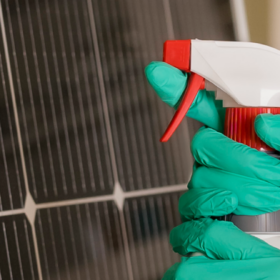
Beware of cleaning photovoltaic panels with dishwashing detergent
Researchers in Finland found that dishwashing liquid reduces solar module transmittance and performance, leaving residues even after rinsing. They recommend avoiding its use for cleaning solar panels.
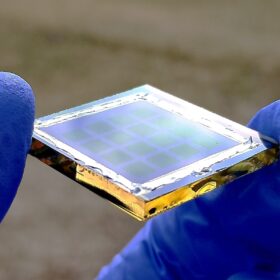
Swedish scientists build bifacial chalcogenide solar cell with 15.1% efficiency
Researchers in Sweden developed a bifacial chalcoprite solar cell using a titanium-doped indium oxide (ITiO) back contact, achieving 68% bifaciality. The device is able to maintain strong front-side performance with around 15% efficiency, 595 mV open-circuit voltage, and 75% fill factor.”
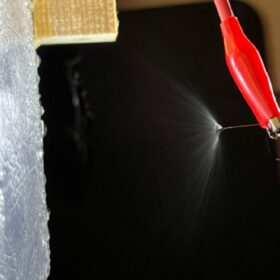
Electrospray cooling can boost PV panel performance with minimal water use
Researchers in Turkey optimized electrospray cooling for PV panels, achieving optimal power output with minimal water use and a compact, energy-efficient setup. Their study identified irradiance, flow rate, voltage, and nozzle distance as ideal parameters.
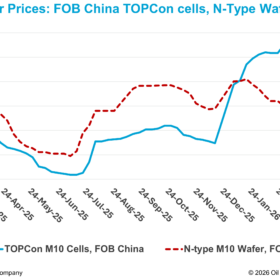
China solar cell prices fall for third consecutive week as upstream costs ease
In a new weekly update for pv magazine, OPIS, a Dow Jones company, provides a quick look at the main price trends in the global PV industry.

Hysolar moves to take control of Suntech
Hongyuan Green Energy (Hysolar) says it plans to take control of Wuxi Suntech Solar Power through a court-led restructuring that transfers core assets into a new entity while isolating legacy debt.
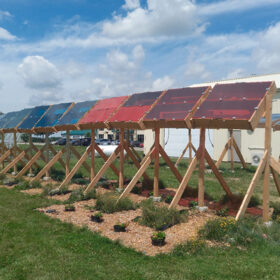
Agrivoltaics for turnips
Researchers in Canada found that semi-transparent cadmium telluride and low-transparency crystalline silicon solar panels can boost turnip root and leaf yields in agrivoltaic systems by optimizing light quality, distribution, and heat stress. Their study highlights that PV module type, transparency, and spectral transmission must be carefully matched to plant physiology to maximize both crop productivity and renewable energy generation.
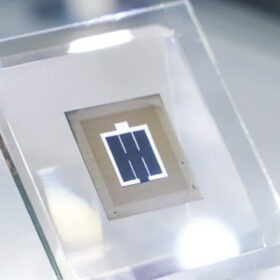
JinkoSolar achieves 32.76% efficiency in perovskite-TOPCon tandem solar cell
The result was certified by China’s National Photovoltaic Industry Metrology Test Center (NPVM). The cell utilizes a perovskite top device with MBT-ligand-controlled crystallization on a TOPCon silicon bottom cell, achieving a void-free, high-efficiency tandem structure.
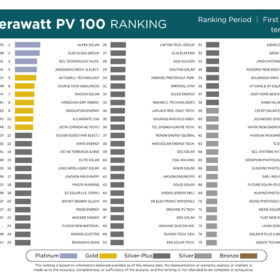
Who are the Top 100 PV manufacturers today?
The Terawatt PV 100 ranks the top 100 solar manufacturing companies using a new methodology based on production scale, financial strength, and corporate transparency, with Tongwei leading the Q1 2026 list and most top firms headquartered in China. The analysis highlights increasing global supply-chain scrutiny driven by tariffs and ESG mandates, while also showing rising influence from Indian companies and strong positions for key materials and equipment suppliers.
