
European Commission could call in Macquarie bid for French developer
Australia’s Macquarie is leading a consortium that has reportedly tabled a €2.5 billion ($2.7 billion) bid for a clean energy business formed by French private equity houses InfraVia and Eurazeo.

Chinese PV Industry Brief: Hoshine expands PV glass output, Tongwei raises cell prices
Hoshine plans to expand PV glass production, while Tongwei is raising PV cell prices, with a particular focus on monocrystalline cells. Maxwell Technology has secured a 4.8 GW production line order from India’s Reliance Industries, while JA Solar has reported a net profit increase of 35% for 2021.
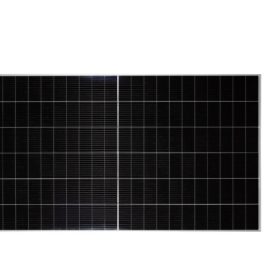
Eging releases 685 W TOPCon PV module with 22.05% efficiency
Chinese manufacturer Eging has unveiled a new line of bifacial TOPCon solar panels based on n-type wafers and 210 mm cells. The modules have a temperature coefficient of 0.31% and efficiencies ranging from 21.24% to 22.05%.
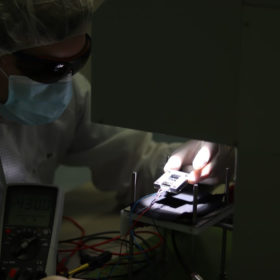
Ultra-thin perovskite-organic tandem solar cell with 24.0% efficiency
Researchers in Germany have built a perovskite-organic solar cell with low interfacial losses and a high open-circuit voltage. The device achieved an open-circuit voltage of 2.15 V, a short-circuit current of 14.0 mA cm−², and a fill factor of 80%.
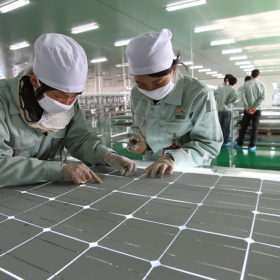
AI method learns from experienced staff on perovskite solar production lines
Academics from MIT and Stanford who have posited a new production method for perovskite solar cells have also developed a machine learning system which benefits from the experience of seasoned workers – and they’ve posted it online for anyone to use.
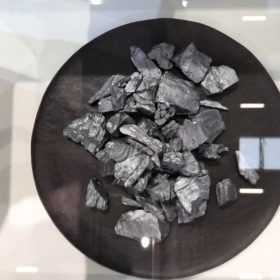
Chinese PV Industry Brief: Polysilicon prices keep rising
The cost of solar panel raw material polysilicon topped $40/kg this week, according to the China Nonferrous Metals Association, continuing a three-month upward trend.

Hybrid thermionic-photovoltaic converter for applications in thermal energy storage, waste heat recovery
A Spanish-Italian research group has developed a solid-state thermal-to-electric energy converter based on hybrid thermionic-photovoltaics (TIPV) for different applications. It consists of a three-terminal TIPV device made with a tungsten (W) thermionic cathode, a PV/anode structure made of an indium phosphide (n-InP) anode, and a photovoltaic cell based on indium gallium arsenide (InGaAs).

Bluetti launches 350 W portable solar module
The new product relies on 23.4%-efficient solar cells and features a short-circuit current of 10.8 A. It can be folded into a briefcase and is claimed to be an ideal solution for camping and outdoor activities.
EU adopts directive allowing reduced VAT on several goods, including solar panels
The Directive No. 2022/542 was published in the Official Journal of the European Union on April 5. According to the new provisions, member states will be free to apply a VAT rate of 0% to 5%.
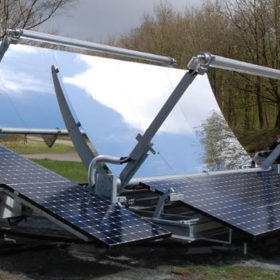
Concentrating solar power system for building applications, usable with PV
Conceived by a German start-up, the system is claimed to achieve a 75% efficiency in converting direct radiation into heat. It may be either equipped with solar trackers or photovoltaic modules, which would both occupy the same space on the front and lateral sides of the installations.
