
Pyrazine polymer PHATNs up cathode in sodium-ion batteries
Scientists at the University of Maryland have developed an organic polymer electrode which they claim demonstrates stable function for a sodium-ion battery over 50,000 cycles and also offers encouraging performance in magnesium-ion and aluminum-ion storage devices.
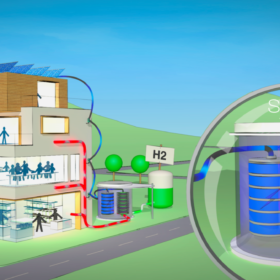
French consortium develops hybrid storage and co-generation system
The Smart Energy Hub can operate in electrolysis mode to store renewable energy as hydrogen, or in fuel cell mode to produce electricity and heat from previously produced hydrogen or methane. Its developers are the French Alternative Energies and Atomic Energy Commission and start-up Sylfen.

EDF Pivots towards bigger electric vehicle and storage activity
The French energy giant has acquired U.K. start-up Pivot Power, which has a 2 GW pipeline of storage projects in Britain.
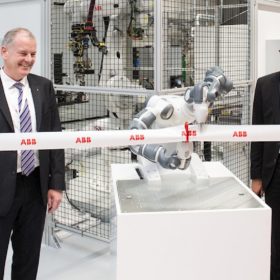
ABB strengthens e-mobility profile and builds digital microgrid at factory
The Swiss multinational has opened a production facility for energy storage systems for the mobility market and placed a 900 kW rooftop array on one of its Italian factories.

Lithium batteries – 1.2m tons ready for recycling by 2030
The recycling market will experience a tenfold expansion between last year and 2030, driven by EV battery usage and portable electronics. Retrieving valuable metals and minerals is becoming a high priority and several dozen companies are already in position for the first big wave of end-of-life batteries.

Scientists double down on hydrogen production
A team of scientists led by the University of Glasgow has discovered a more efficient method of splitting water into hydrogen and oxygen using electricity which it says could almost double the amount of hydrogen produced per millivolt.

Kosovo preps 50 MW solar tender
The Balkan nation is planning a tender for 50 MW of utility scale solar capacity on a public-private partnership basis with help from the International Finance Corporation. The World Bank’s private finance arm is procuring a technical, environmental and social consulting firm to advise on the project.

Swedish Solar Expo touts solar and hydrogen community project
Where seasonal storage is paramount, hydrogen comes into play. Under-the-radar solar market Sweden has presented its hydrogen projects and technological solutions to overcome the country’s natural solar barriers.

Is Eskom turning to solar?
The South African utility has issued a 20-strong tender for 50 kW solar inverters and mounting structures, to be used in four power plants. Although it is unclear whether the tender marks the energy company’s first step into solar energy, the procurement follows the recent publication of South Africa’s Integrated Resource Plan. Eskom is reportedly developing a renewables-linked large scale storage project which may explain the need for inverters.

UK’s Labour announces plans for 22 GW of new solar capacity by 2030
Although PV trails wind and nuclear in terms of its anticipated future footprint, the opposition party’s attempt to outflank left of center rivals on climate change has resulted in one of the world’s most ambitious national roadmaps towards a zero-carbon future.
