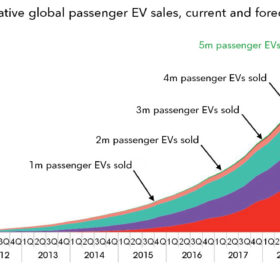
Global EV sales hit 4 million, soaring market sees next million in May 2019
While it took 60 months to reach the first million electric vehicle (EV) sales, in late 2015, it took the fourth million just six months. China is driving this development. Meanwhile, as first generation EVs batteries are reaching their end-of-life, interest in second-life use cases is growing. The volume of retired EV battery packs is set to be 108 GWh by 2029 – representing a third of the expected storage capacity market at that time.
Africa: UK announces £56 million for battery storage, support for solar
The U.K. Government says it will make £56 million available for battery storage technologies in South Africa. Nigeria also saw the next phase of the U.K.-Nigeria Climate Finance Accelerator unveiled; while the continent as a whole, is set to benefit from further partnerships and investment in both solar and climate change.
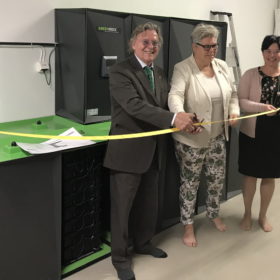
Swedish school installs saltwater battery, highlights environmental benefits
Saltwater batteries can be fully recycled receiving a “cradle to cradle” certificate, and don’t contain lead or lithium. For some, this prevails over the disadvantages of saltwater batteries being considerably bigger and heavier, as well as having a lower discharging current than lithium-ion batteries.

Europe surpasses 1 million EV milestone
The market experienced strong growth in nearly all states. Scandinavian countries lead the charge, but Germany showed strong growth in the first half of 2018, analysts report. An uptake in EV sales might result in profound effects on their use as flexible storage units, recent reports and interviews suggest.
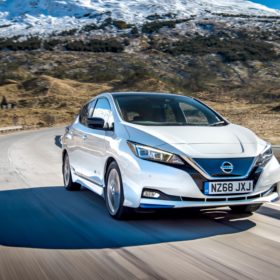
Nissan: ‘EVs are at the core of our company’
Nissan recently supplied batteries to Europe’s largest energy storage system using new and second-life batteries in a commercial building. At the inauguration ceremony, Nissan’s Head of Energy spoke about the car manufacturer’s role in the project, and why EVs are playing an increasingly central role.
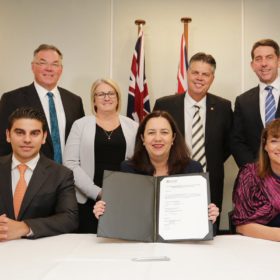
Australian Li-ion battery factory study gets financial shot in the arm
Following the signing of an assistance agreement between the Queensland Government and international consortium Imperium 3, an AU$2 billion lithium-ion battery factory is one step closer to reality.
Batteries material market set to grow 9% until 2022
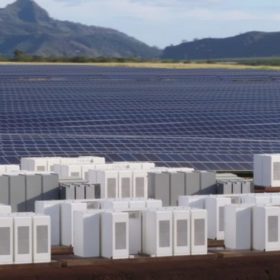
A report by Technavio suggests the global market for battery materials could grow 9% annually in the next four years. Analysts point to the increasing installation of storage systems with PV as a key driver. pv magazine has covered previous reports predicting significant growth in PV and storage systems.
Bosch and Ceres planning fuel cells to power future cities
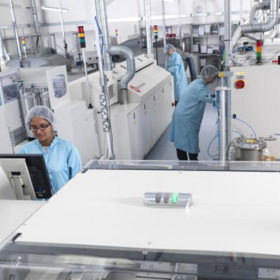
The Stuttgart-based industrial group wants to work on technology development and production with the British fuel cell manufacturer. Bosch considers highly efficient fuel cells an important step forward in the energy transition.
First utility-scale battery helps relieve stress on UK’s national grid
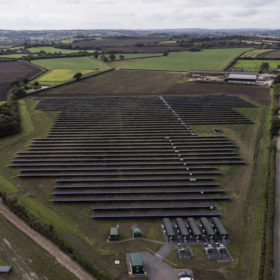
A 10 MW system in Derbyshire provided power to the grid as part of a virtual power plant in a national first. It should prove a popular development, according to the results of a new survey.

Fluence to partner with PUC for peak-load shaving in Ontario
PUC Distribution contracted Fluence to install energy management and storage systems that would allow business in a city in Ontario to reduce high peak-load charges. It is hoped this will reduce costs and help Canada hit its strict carbon emissions mandate.
