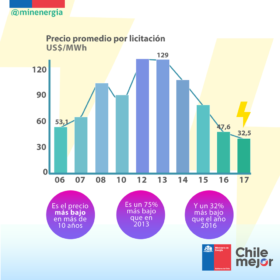
Chile’s auction concludes with average price of $32.5/MWh
The Chilean government has allocated approximately 600 MW of renewable energy capacity in the auction.

UK: Government survey shows strong public support for solar
Latest results from an ongoing public survey conducted by the British government show that support for solar and renewables is strong and growing across the country. Industry associations continue to call for better policies to support growth in renewable energy.
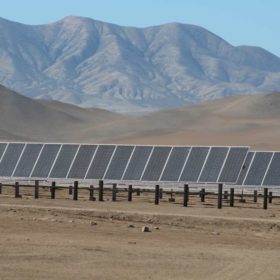
Chile: Lowest bid in electric auction reaches $21.48/MWh
The bid was submitted by Enel Generación Chile, a subsidiary of Italian energy giant Enel. The second lowest bid was presented by GPG Solar Chile, a unit of Spanish company Gas Natural Fenosa. At the auction, 2,200 GWh will be allocated, successful bids will be publicly announced on November 3rd.
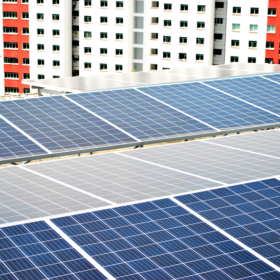
Singapore announces 50 MW rooftop PV tender
Singapore’s Housing and Development Board has launched its latest tender for 50 MW of new PV capacity under the SolarNova program. This will be largest tender so far in the SolarNova series, involving several new government agencies.

USITC recommends quotas, tariffs on crystalline silicon solar imports
The rulings by the separate commissioners are diverse, however neither quotas nor tariffs are being recommended at the levels called for by SolarWorld and Suniva.
Czech solar association calls for policies to support industry growth
As Czech politicians negotiate to form a coalition government after the recent elections, the country’s solar association Solarni Asociace calls for stability, and warns incoming policymakers against the politicization of supporting for solar.
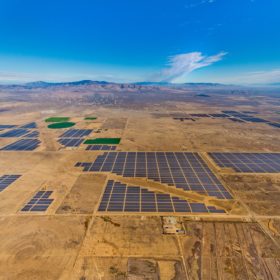
5 questions for the Section 201 trade case
In this analytical piece, IHS Markit takes a look at the potential effects of the Section 201 case, both in the United States and globally.
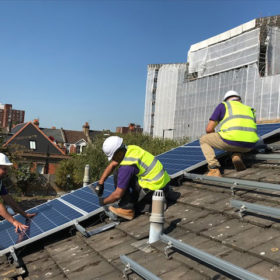
UK: Industry bodies respond to Cost of Energy review
An independent review into the cost of energy across the UK supply was published earlier this week. The review has seen a mixed response from the renewables segment, and has been criticized by industry bodies for failing to recognize the opportunities presented by a decentralized energy system focused on renewables.
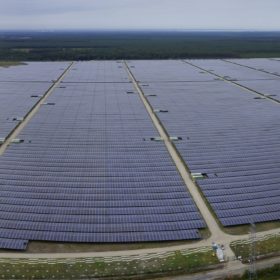
SolarPower Europe: Global solar market to reach 100 GW in 2017
The latest market analysis from industry body SolarPower Europe predicts that global PV demand will reach the 100-gigawatt mark for the first time in 2017.
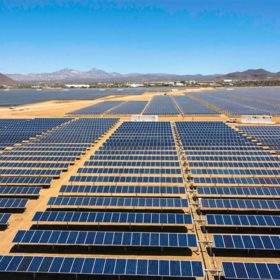
BNEF shines light on China’s solar curtailment problem
Approximately 56.2 TWh of solar and wind generation was curtailed in China last year, underscoring how excessive investment and an oversupply of electricity pose an ongoing threat to renewables development, according to newly released research.
