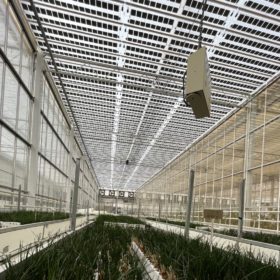
PV shade screens for greenhouses, agrivoltaics
A Saudi Arabian startup has developed a modular solar panel for agrivoltaic applications. It is specifically designed for locations with high solar radiation levels and protects plants and crops from excess sunlight.
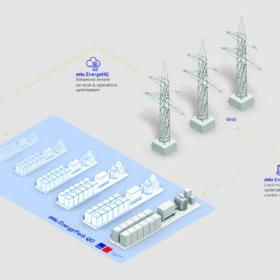
Rolls-Royce to supply largest battery in Netherlands
Rolls-Royce has agreed to install a 30 MW/60 MWh storage system based on nickel-manganese-cobalt (NMC) batteries in the Netherlands. It will be the country’s largest energy storage system upon completion in spring 2023. It will provide grid frequency regulation services to the Dutch grid.
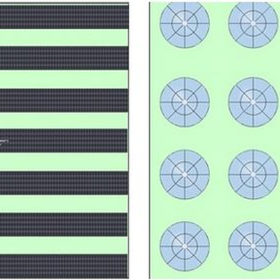
Photovoltaics vs. concentrated solar power
Omani researchers have compared the performance of PV and concentrated solar power (CSP) in terms of energy generation intensity and the effective use of land at low latitudes near the Tropic of Cancer. They described nine project typologies and ranked them with three different simulation tools.

The Hydrogen Stream: TES, EWE plan 500 MW electrolyzer in Germany
A group of German companies plans to set up a 500 MW electrolyzer for a 1 GW green hydrogen project in the North Sea. US scientists, meanwhile, have engineered a light-activated nanomaterial to convert ammonia into hydrogen, and Canadian researchers have unveiled a new way to structure catalysts for fuel cells.

Low-breakdown-voltage TOPCon IBC solar cells to improve shading tolerance
Scientists in the Netherlands have looked at how TOPCon IBC solar cells could help to reduce the impact of shading on solar modules.
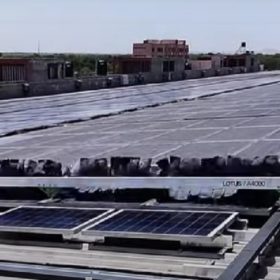
Greenleap Robotics unveils fully autonomous robot to clean solar panels
Greenleap Robotics has built the Lotus A4000 cleaning robot with automotive-grade components to serve as a reliable way to clean solar panels in arid regions.
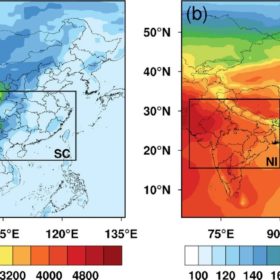
Impacts of clouds, aerosols on solar in China, India
Chinese researchers have modeled the impacts of clouds and aerosols on PV potential in southern China and northern India, which are similar in terms of latitude and elevation. They found that China offers lower PV potential due to a higher cloud effect.

Beny Electric launches new battery for residential applications
The Chinese manufacturer said its new modular product has a storage capacity of 2.5 kWh and a nominal voltage of 48 V. It can be flexibly scaled up in a four-device configuration to 10 kWh.
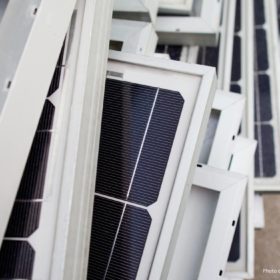
Japanese consortium launches first warranty scheme for second-life solar
Japan-based Marubeni and Sompo Japan have partnered to provide defect warranties for second-life PV modules. Marubeni will verify the traceability and authenticity of information on the panels using blockchain technology.
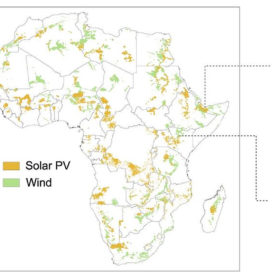
IRENA releases all-Africa dataset of locations for solar, wind
The International Renewable Energy Agency (IRENA) has published a dataset with 10,905 sites for PV deployment across Africa, with an estimated total capacity of 4.9 TW.
