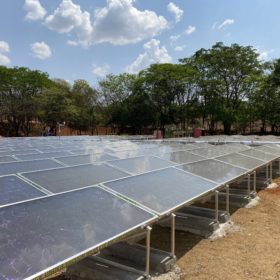
Solar thermal panel for large scale applications
The panel has an absorption area of 1.96 m2 and a weight of 27 kg per square meter. According to the manufacturer – Swiss startup TVP Solar – it may be a real booster for thermal output, by combining it with photovoltaics and heat pumps to provide enhanced output per square meter, in particular for low-temperature applications such as district heating.

New kind of black silicon shows improved light-trapping properties
Scientists in Russia have developed a new wide-band optical absorber called ‘black silicide’ which they claim is more adjusted to match AM-1.5 solar spectrum with theoretically higher photogenerated current density. It could be used for tandem operation in photovoltaic devices.
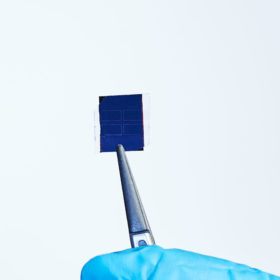
Monolithic perovskite-silicon solar cell with 20% efficiency via new lamination approach
The solar cell achieved an open-circuit voltage of 1.75 V, a short-circuit current density of 15.5 mA cm−2, and a fill factor of 73.6%. It was also able to retain 93% of its initial efficiency after 100 hours at a temperature of 80 C.

The Hydrogen Stream: Gas prices are higher than levelized cost of hydrogen for several technologies in Europe
In other news, Toyota unveiled plans to roll out light-duty hydrogen fuel-cell trucks for the Japanese market next year and the UK has launched a contract for difference scheme for large scale hydrogen projects. Furthermore, Japanese scientists have designed a ruthenium complex with a nitrogen-containing organic compound to improve high-temperature proton conduction in fuel cells.

Project to build 1.4 GW high-voltage cable linking Germany with the UK moves forward
The European Investment Bank has agreed to provide €400 million ($406.5 million) in funds for the €2.8 billion project. Construction on the infrastructure should begin by the end of this year.
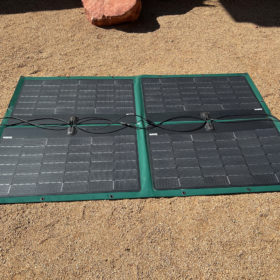
Portable flexible PV systems for off-grid, residential applications
US startup New Use Energy Solutions has launched a new line of portable PV systems built with a module technology provided by Merlin Solar. The modules are assembled in the system via a custom vinyl tarp.
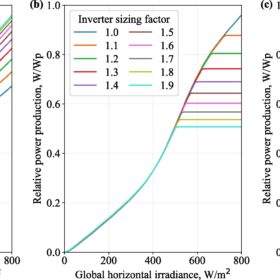
The right tilt angle, inverter sizing, row spacing for optimal yield forecast
Researchers in Hungary have found that a high tilt angle may increase power forecast errors in a PV installation by up to 49%. They also ascertained that
undersizing the inverters by a sizing factor of 1.5 may reduce forecast errors by up to 25%.
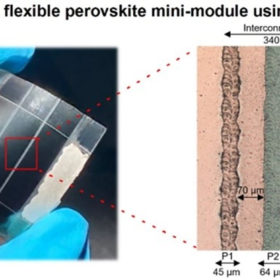
Four-terminal flexible perovskite-CIGS tandem mini-module with 18.4% efficiency
Swiss scientists have built a 4T tandem perovskite/CIGS mini-panel with a geometric fill factor of over 93%. It combines a 10.8%-efficient mini perovskite module and a 15.1%-efficient CIGS device.

Australian startup unveils scalable shade solution for commercial applications
Canyon Solar has unveiled a prefabricated solar PV shade structure for commercial carport applications that it claims can be installed at least three times faster than traditional systems and outcompetes rooftop solar PV on a dollar-per-watt basis.

Solar panel sizes continue to get larger and improve LCOE, says TrendForce report
A new report from the Taiwanese market research company shows growth in the production of modules over 600 W and increased format size. Cells and wafers are getting larger as well.
