
New kind of black silicon shows improved light-trapping properties
Scientists in Russia have developed a new wide-band optical absorber called ‘black silicide’ which they claim is more adjusted to match AM-1.5 solar spectrum with theoretically higher photogenerated current density. It could be used for tandem operation in photovoltaic devices.
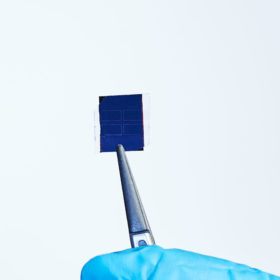
Monolithic perovskite-silicon solar cell with 20% efficiency via new lamination approach
The solar cell achieved an open-circuit voltage of 1.75 V, a short-circuit current density of 15.5 mA cm−2, and a fill factor of 73.6%. It was also able to retain 93% of its initial efficiency after 100 hours at a temperature of 80 C.

The Hydrogen Stream: Gas prices are higher than levelized cost of hydrogen for several technologies in Europe
In other news, Toyota unveiled plans to roll out light-duty hydrogen fuel-cell trucks for the Japanese market next year and the UK has launched a contract for difference scheme for large scale hydrogen projects. Furthermore, Japanese scientists have designed a ruthenium complex with a nitrogen-containing organic compound to improve high-temperature proton conduction in fuel cells.
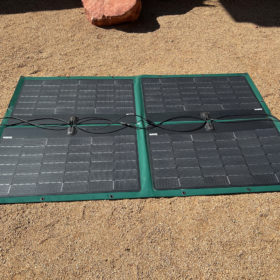
Portable flexible PV systems for off-grid, residential applications
US startup New Use Energy Solutions has launched a new line of portable PV systems built with a module technology provided by Merlin Solar. The modules are assembled in the system via a custom vinyl tarp.
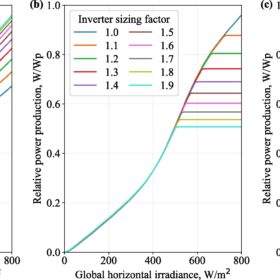
The right tilt angle, inverter sizing, row spacing for optimal yield forecast
Researchers in Hungary have found that a high tilt angle may increase power forecast errors in a PV installation by up to 49%. They also ascertained that
undersizing the inverters by a sizing factor of 1.5 may reduce forecast errors by up to 25%.
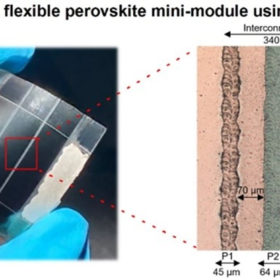
Four-terminal flexible perovskite-CIGS tandem mini-module with 18.4% efficiency
Swiss scientists have built a 4T tandem perovskite/CIGS mini-panel with a geometric fill factor of over 93%. It combines a 10.8%-efficient mini perovskite module and a 15.1%-efficient CIGS device.

Australian startup unveils scalable shade solution for commercial applications
Canyon Solar has unveiled a prefabricated solar PV shade structure for commercial carport applications that it claims can be installed at least three times faster than traditional systems and outcompetes rooftop solar PV on a dollar-per-watt basis.

Solar panel sizes continue to get larger and improve LCOE, says TrendForce report
A new report from the Taiwanese market research company shows growth in the production of modules over 600 W and increased format size. Cells and wafers are getting larger as well.

Comparing performance of transparent solar windows to traditional windows
The results of the study by Wells Fargo Foundation and NREL initiative showed that PV-coated windows can appreciably lower the solar heat gain coefficient.

New photovoltaic tiles from Estonia
Estonian startup Solarstone has developed two solar tiles with an efficiency of up to 19.5% and an operating temperature coefficient of -0.41% per C. It recently secured €10 million in funds to expand sales across Europe.
