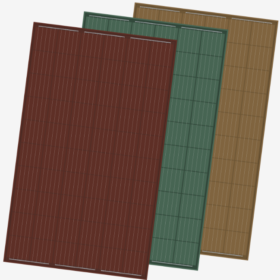
Colored BIPV panel with 350 W output from Italy
Italian manufacturer Solarday has launched a glass-glass building-integrated monocrystalline PERC panel available in red, green, gold and grey color. Its power conversion efficiency is 17.98% and its temperature coefficient is -0.39% per degree Celsius.
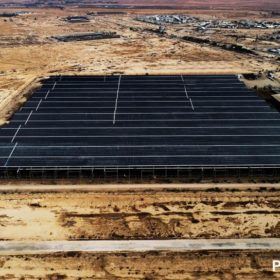
Israel allocates 1.14 GW of PV across two tenders, lowest price comes in at $0.02751/kWh
The Israeli authorities allocated more than 1.14 GW of PV capacity and 210 MWh of storage across two different tenders. In a first procurement exercise for the 330 MW/210 MWh Dimona solar-plus-storage project the winner was Israeli company Shikun & Binui Holdings Ltd. In another tender for innovative PV projects local developer Prime Energy secured 475 MW with the final average price of $0.0541/kWh.
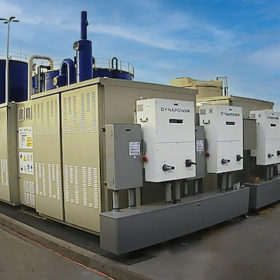
Australian flow battery company completes ‘milestone’ installation
Brisbane-based flow battery company Redflow has completed its single biggest installation to date, a 2 MWh storage system in California for biowaste technology firm Anaergia.
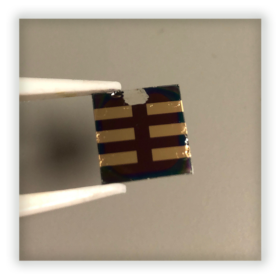
Paired with ‘wonder material,’ over 21% efficiency demonstrated in perovskite solar cells
The use of phosphorene nanoribbons boosted the cell, putting it on par with traditional silicon cell output levels.
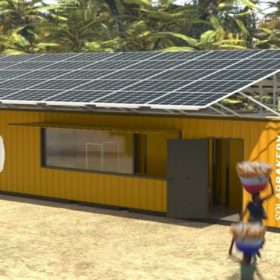
Solar bakery as a containerized solution
The 52 kW containerized solution is being developed by German start-up Solarbakery. The bakery’s production process was adapted in such a way that the majority of electricity consumption is already incurred during the day and is only baked briefly in the dark before dawn.
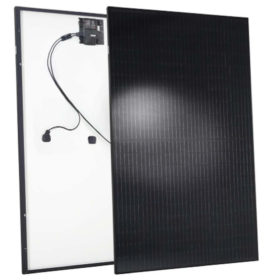
Hanwha Q Cells, Enphase launch 20.6%-efficient AC module in Europe
The AC module incorporates Enphase IQ 7+ microinverters and has now a higher wattage of 385 W.

Norwegian investor raises stake in company developing ‘perovskite-boosted’ solar cells
Swedish business Evolar is working on a bolt-on piece of production equipment which would upgrade the cell lines of conventional manufacturers with a perovskite lift in performance.
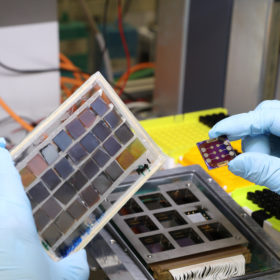
Perovskite solar cell retains 99% of initial efficiency after 1,450 hours
Developed by German researchers, the 20.9%-efficient device was built with an architecture avoiding the use of the ionic dopants or metal oxide nanoparticles that are commonly used to contact the cell, as these can be subject to secondary reactions at higher temperatures.
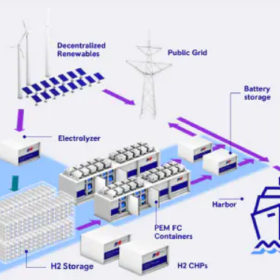
The Hydrogen Stream: Fuel cell solutions for electrical peak load coverage
Rolls-Royce is supplying its mtu hydrogen technology for the container terminal currently under construction at the Port of Duisburg in Germany. Furthermore, German energy company RWE wants to produce green hydrogen at the Pembroke Power Station site in Wales and Norway’s Scatec discussed plans for large-scale seawater desalination, hydrogen and ammonia production based on renewable power with the Egyptian government. Meanwhile, the EU has adopted a set of legislative proposals to decarbonize the EU gas market by facilitating the uptake of low carbon gases, including hydrogen.
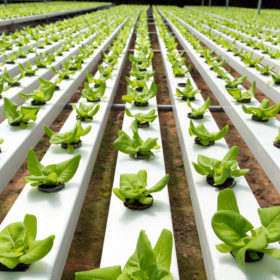
Solar for hydroponics
An international research team has examined combining solar power generation with energy-intensive hydroponic horticulture and has found that this may be a viable solution depending on project size and available incentive policies. Their approach considered various factors impacting PV system efficiency, including environmental factors, the type of solar array, and the electricity demand from the hydroponic farm.
