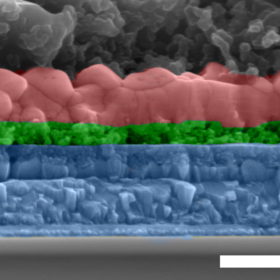
Japanese scientists trial printing on perovskite
Researchers from three Japanese universities have developed a process based on inkjet printing they say could reduce the cost of perovskite solar cell production. The group fabricated small cells with efficiencies as high as 13.19%, a figure they claim is promising enough to offer the possibility of scaling up to commercial production.

Russian scientists unveil new manufacturing process for III-V solar cells
Researchers have integrated A3B5 semiconductors on a silicon substrate in a prototype solar cell and claim the technique could enable the production of III-V solar cells with conversion efficiencies of around 40%.

Energy density advances and faster charging would unlock EV revolution
With electric vehicles making up only 3% of the global car market last year, analyst WoodMac says battery packs need to be cheaper and lighter and range anxiety must be addressed to change the habits of drivers.

Greening greenhouses with organic PV
Semi-transparent organic solar cells can reduce the carbon footprint and raise the crop yield of greenhouses while acting as generators and insulation. Scientists in the U.S. say greenhouses equipped with organic cells could be energy self-sufficient year round in hot and moderate-humidity climates.

Perovskite production without the side-effects
Chemists from Russia’s RUDN University have developed a series of compounds based on methylammonium iodide and iodine which they say could be used to make perovskite solar devices without toxic solvents. That would enable perovskite cells to be manufactured without chemical by-products.

Recycling heat for a ‘385% efficient’ solar desalinator
MIT scientists have developed a solar desalinator which transports heat from the sun through a ten-stage process of evaporation and condensation. The group estimates a $100 device employing their innovation could provide the daily drinking water needs of a family.

Improving magnesium-based batteries with chaos
Researchers have found strong anodic activity in disordered particles of magnesium chromium oxide. Unlike conventional, ordered nanocrystals, the disordered particles reportedly achieved reversible magnesium extraction and insertion.
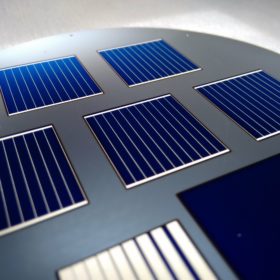
Silicon heterojunction solar cell hits 23.5% efficiency with new hole-selective contact
Researchers from Switzerland’s École Polytechnique Fédérale de Lausanne have used molybdenum oxide as the hole-selective contact in an heterojuction silicon cell. The scientists claim the compound can compete with traditional contacts despite a lower level of optimization.

MIT researchers say PV innovations should be deployed in niche markets first
Solar module manufacturers should begin testing new technologies in higher-value niche markets, say scientists at the U.S. institution. For example, bringing perovskite technology directly to the mainstream market remains prohibitive in terms of initial investment but segments such as building-integrated PV or microelectronics devices may offer better routes to commercial maturity.

Hunting hidden electricity in crystalline solar cells with new encapsulation technique
Korean researchers claim it is possible to extract more than 10% of ‘hidden electricity’ in crystalline solar cells using a new encapsulation process based on poly‐dimethylsiloxane coatings and a three-dimensional module structure. Compared to EVA films, the new coating is said to avoid cutting off short-wavelength light.
