
The Chinese solar market is changing shape
Two reports have described how the world’s largest renewable energy market is moving towards maturity. According to the Brookings Institution, the Chinese clean energy market could become more open to Western investors and tech. A report by Fitch claims projects are moving back to inland provinces from coastal regions.

Take a break on the solar bench – but not for too long
Engie has raised eyebrows with the installation of several solar benches in Biarritz, southwestern France, as a local official has asked citizens to avoid sitting on them for long periods of time in order to keep their energy yield up. But the authorities over in Cannes are clearly impressed, as the municipal government in the French Riviera resort town has also revealed plans to buy more of the PV benches, which are designed by Croatian startup Include.

Japanese scientists develop dye-sensitized cell with 10.7% efficiency
The improved performance was achieved by using a methylene bridged material, the molecular dye DfZnP-iPr.

PV for cooking
Traditional solar cookers concentrate sunlight on mirrored surfaces and convert it into heat. But this summer, Sunspot unveiled Sunspot Solar Electric Cooking, a new cooker based on PV technology. The system relies on two PV modules, a lead-carbon battery, an inverter, and an induction cooktop.

Global warming will hit solar panel performance
MIT researchers say climate change could reduce the yield of solar modules. Analysis based on the warming scenarios outlined by the IPCC predicts in some areas the annual energy output of PV systems may fall by up to 50 kWh per kilowatt installed.
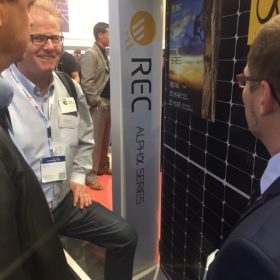
Meyer Burger abandons plan to relocate operations to China
The Swiss equipment maker is instead preparing to commit its future to PV in its European heartland and will start with plans to help Norwegian module maker REC Solar embark on a gigawatt-scale production expansion.

Exciting excitons
A research team from Columbia University has designed organic molecules that can produce excitons with a longer lifecycle than inorganic equivalents. The excitons have the potential to amplify the amount of electricity generated by the photons a solar cell absorbs.

Nanowire mesh offers better cell performance and lower costs
A new method of creating an ordered mesh of nanowires, developed by scientists at the Lawrence Livermore National Laboratory in the United States, could lead to the creation of more efficient transparent electrode layers in solar cells – and the elimination of a rare material from the manufacturing process.

A new spectroscopic method to understand the physical principles of organic PV
A German research team claims to have created a new visualization technique it says can enable detailed mapping of the energetic landscapes of organic PV cells on a nano scale. The technique could lead to organic cells with reduced power losses.

‘New and strange properties’ provide a boost to energy storage
MIT scientists have developed a class of liquid electrolyte with properties they say could open up new possibilities for improving the performance and stability of lithium batteries and supercapacitors.
