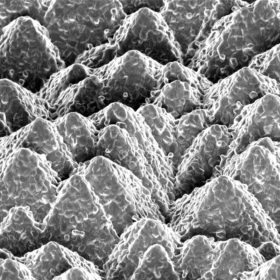
EPFL produces 25.2% silicon-perovskite tandem, ‘cost competitive’ production claimed
Crystalline silicon tandem cell structures show great promise in delivering efficiencies beyond the limits of conventional c-Si. Swiss researchers claim to have gone beyond 25% with a c-Si-perovskite tandem cell structure, using what they claim is a competitive production process.

Korean researchers propose new material for stable, lead free perovskite
A team of scientists from the Korea Advanced Institute of Science and Technology (KAIST) has proposed a gold-based halide perovskite as a material for high efficiency solar cells, which it says could be both more stable and more environmentally friendly to produce than many existing perovskites which scientists are investigating to boost solar efficiency.
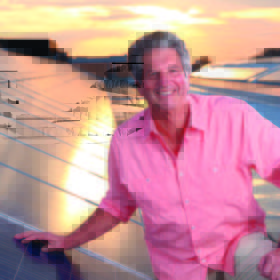
Australian solar researcher Martin Green awarded Global Energy Prize
Pioneering UNSW solar researcher Martin Green has received wide recognition for his achievement as being selected as one of the winners of 2018 Global Energy Prize. The prize has brought with it $820,000 towards Green’s research and teaching, and a congratulatory call from Prime Minister Malcolm Turnbull.
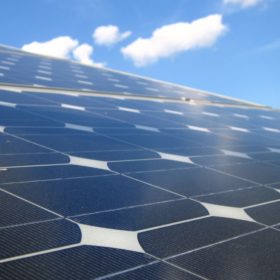
SOLAR-ERA.NET launches €22 million call to co-fund development of innovative solar technologies
Through the joint call, the European organization is seeking to provide financial backing for, among other PV and CSP technologies, high-performance crystalline silicon and thin film technologies which can increase module efficiency and decrease turn-key system costs.
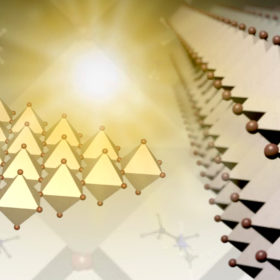
U.S. scientists develop scale for measuring perovskite energy
A team from Rice University and Los Alamos National Laboratory has been able to observe electronic properties of perovskites at the quantum scale, and made discoveries likely to impact the development of perovskite solar cells.

India to launch its own battery cell production
India’s PV sector is expanding at a serious pace, creating jobs and further securing energy supply for many businesses. Yet, sourcing battery cell technology at the current rate resulted in annual foreign exchange of $150 million creating deficits, that hopefully can be averted in the future.

Solaredge: Designing rooftop system with new web-based software
With a growing global residential PV market, software solutions to optimize rooftop systems have spawned. Last year the PV market grew by 29% with no sign of decelartion in sight. Optimizing installations and making them as convenient as possible has thus become a hotter market recently.
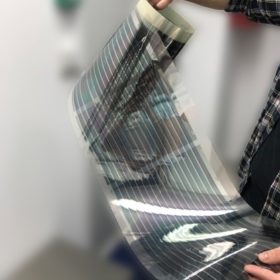
Greek researchers hit new efficiency landmark for single-junction OPV cells
While intriguing, OPV technology has yet to achieve the commercial efficiency yield to be a serious competitor. Research institutes and companies worldwide are exploring compound and manufacturing methods as organic PV yields rise.
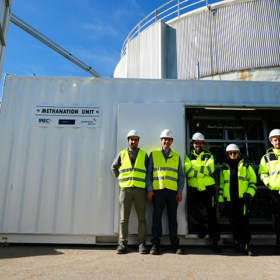
Gas Natural Fenosa launches power-to-gas project as advocates of the technology call for policy clarity
The Spanish power provider developed the pilot project with the Institut de Recerca en Energia de Catalunya and German spin-off Ineratec. Meanwhile, the European Power to Gas Platform has issued a paper demanding more regulatory certainty for power-to-gas, and to include it as an alternative in the cost-benefit analysis for grid extensions.
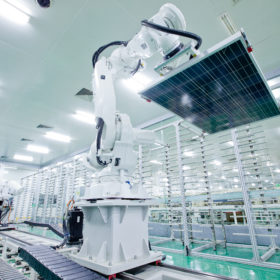
Jinko’s approach to PID-resistant PV modules
Talking to pv magazine, Andrea Viaro, head of technical service Europe for JinkoSolar, explains how the Chinese manufacturer is dealing with PID degradation.
