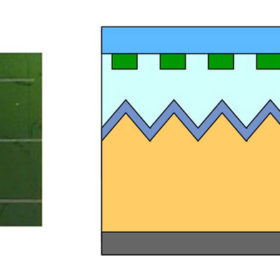
Researchers one step closer to efficient, colorful solar panels
Researchers at the Netherlands’ AMOLF Institute have developed a method for imprinting solar panels with silicon nanopatterns that scatter green light back towards the observer.
Natcore to consult on 20 MW project in Ghana
After the 20 MW PV project planned in the Central region of Ghana was threatened with a 29% feed in tariff reduction, UK based solar developer PSECC Solar Farms turned to Natcore, with the aim of bringing in higher efficiency technology that would make the project financially viable.
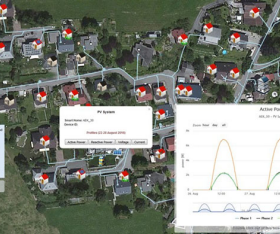
Swiss university spin-off develops grid analysis software
Zurich based startup Adaptricity, which grew out of leading university the Swiss Federal Institute of Technology (ETH Zurich) is preparing to launch a software system which can simulate and analyze regional electrical grids, potentially a valuable tool for investors and grid operators.

Researchers use polystyrene to upgrade perovskite solar cells
Polystyrene does not only bring down manufacturing costs of perovskite solar cells, but also improves their stability, researchers show.
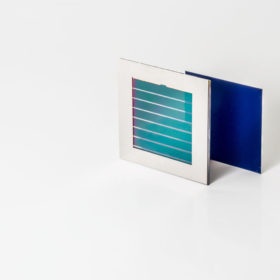
Imec hits 23.9% efficiency on 4cm² tandem perovskite/silicon module
Belgian research institute Imec has achieved a conversion efficiency of 23.9% on a perovskite/silicon tandem module measuring 4 square centimeters. This efficiency level, according to Imec, represents the first time such a stacked configuration has outperformed a standalone silicon solar cell.

‘Solar sunglasses’ demonstrated by researchers at KIT
Scientists at Karlsruhe Institute of Technology (KIT) in Germany have developed a pair of sunglasses that generate electricity through semi-transparent organic solar cells applied to the lenses. The team aims to demonstrate the potential of organic solar to be integrated into electronic devices, buildings and other applications not possible with conventional PV technologies.
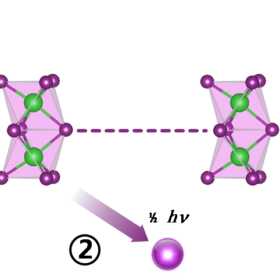
St. Andrews University discovery could push solar cell’s theoretical efficiency limit
Researchers at the University of St. Andrews have demonstrated that atomically precise groups of nanoparticles known as nanoclusters can cut a single high energy photon into two lower energy ones, a discovery which could lead to major advancements in the development of solar cells.

MIT researchers develop ‘any surface’ solar cell
A team of scientists from the Massachusetts Institute of Technology Energy Initiative has developed a flexible, transparent solar cell, using low-cost organic materials and graphene. The researchers say this cell could turn virtually any surface into a source of power generation.

Study finds that storage prices are falling faster than PV and wind technologies
A study from the University of California and TU Munich in Germany shows that long-term R&D spending played a critical role in achieving cost reductions.
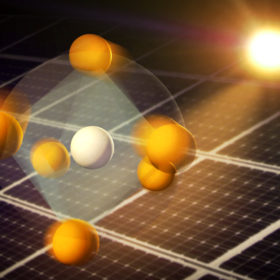
Stanford & DOE research brings insight into perovskite efficiency
Scientists at the Department of Energy’s SLAC National Accelerator Laboratory have published research revealing unusual atomic motions in perovskite materials exposed to light. The discovery, says Stanford, could prove crucial to further increasing the efficiency potential for perovskite solar cells.
