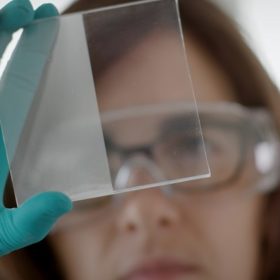
Netherlands: Anti-soiling coating for extra PV power boost, finds DSM
The Dutch materials specialists have conducted new field tests in China that show how its new anti-soiling coating can keep solar panels cleaner for longer, resulting in additional yield on solar modules.

Solar heavyweights Heraeus and JinkoSolar team on PV Super Cell partnership
The agreement between the German metallization solutions company and the leading Chinese Tier-1 solar manufacturer will see the two companies jointly develop ‘Super PV Cells’ in what is the third such strategic partnership between them.
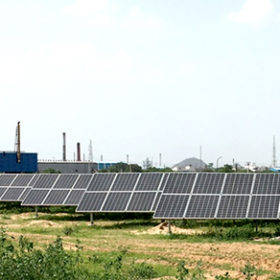
International research team uses algorithm to reduce negative impact of inertia emulation of PV in micro-grids
The computer-based algorithm seeks to make the micro-grid work like a large power grid with inertia, thus improving its stability and reliability.
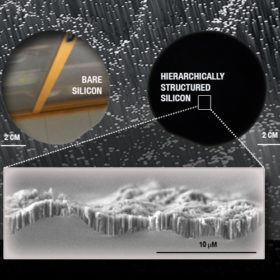
US scientists use nanoscale structures to lower reflectivity in solar cells
The researchers used micro- and nanometer length structures to develop anti-reflective coatings to reduce reflectivity in optical devices such as solar cells, glasses and cameras.
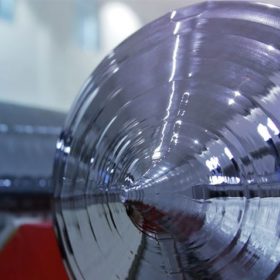
EU Researchers achieve breakthrough in nano-scale c-Si
A team of scientists representing the photoNvoltaics project, funded by the European Union, has been able to develop a crystalline silicon cell with an effective thickness of just 830 nano-meters.

Future PV: The feasibility of solar-powered hydrogen production
There is a solid business case to combine PV plants with electrolyzers, as generation costs are low enough to competitively produce hydrogen as a fuel, says Bjørn Simonsen of NEL Hydrogen. He will speak at pv magazine’s Future PV event at SPI in Las Vegas.
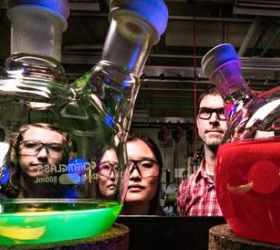
Perovskite has changed its status to single (cell)
In another breakthrough for the material so many solar advocates hope will replace traditional silicon in module production, a group of scientists in China and the United States have produced the first monocrystalline perovskite cell, which could accelerate its acceptance as a silicon replacement.

U.S Researchers look to plant photosynthesis to improve solar efficiency
A team of scientists at Georgia State University has discovered a process that occurs naturally in plants. Known as ‘inverted-region electron transfer’, better understanding of this process could contribute to the design of higher efficiency solar cells, says the University.
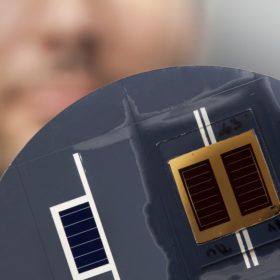
Swiss researchers team with NREL to break 35% cell efficiency
A collaborative project between the U.S. National Renewable Energy Laboratory, the Swiss Center for Electronics and Microtechnology (CSEM) and the École Polytechnique Fédérale de Lausanne (EPFL) has tested a range of multi junction cells in tandem configuration, and achieved efficiencies of up to 35.9%.
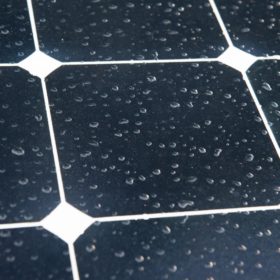
Dutch researchers model perovskite performance
A team of researchers at the Netherlands’ AMOLF institute has modelled the performance of tandem perovskite/silicon solar cells under real-world climate conditions, and found that the tandem cells are little more efficient than the Si cell alone. The research shows, however, that if correctly optimized, this type of cell could perform at efficiency levels above 38%.
