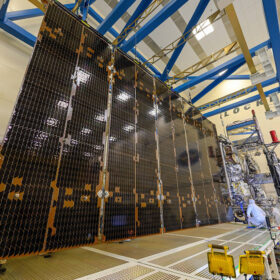
Fold-out NASA satellite solar array undergoes successful test deployment
The NASA/NOAA satellite, part of the GOES-R series, operated as expected in its terrestrial test, making it one step closer to launch.

Weekend Read: Japan turns to the rooftop
Japanese policymakers are now looking at rooftop solar panels as land is scarce in the country and agrivoltaics, building-integrated PV (BIPV), and floating solar are still in their infancy, reports Mark Hutchins.
Shanghai Tianchen enters solar cell production with 20 GW factory
The Chinese investment firm said the factory will have an initial solar cell capacity of 5 GW and will also produce storage systems. The project requires an investment of CNY 11.6 billion ($1.67 billion).
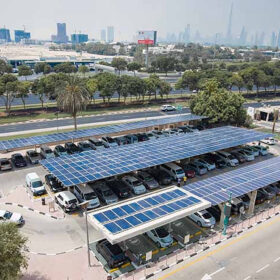
United Arab Emirates’ solar market
The UAE is expected to generate 25% of its electricity from solar energy and have a total installed solar capacity of 44 GW by 2050. The Middle East Solar Industry Association (MESIA) describes the challenges the country has to address to make this target achievable.
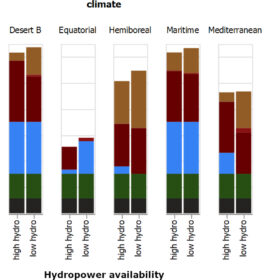
The Hydrogen Stream: Electrolysis is cost-efficient in all climates, says Finnish team
Researchers at the VTT Technical Research Centre of Finland said that chemical energy storages were needed for short and long-term balancing in every climate region, especially in the northern climates. Meanwhile, companies are moving forward with their plans to produce hydrogen in Namibia and Morocco.
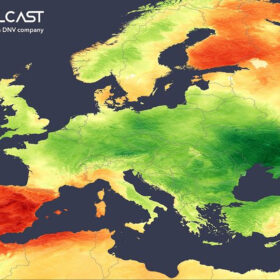
Low pressure impacted Europe PV production in April
In a new weekly update for pv magazine, Solcast, a DNV company, presents the solar irradiance data it collected for Europe in April. These data show that Spain benefitted from solar irradiance 20% to 30% above average during the last month, while in the rest of Europe irradiance was below average.
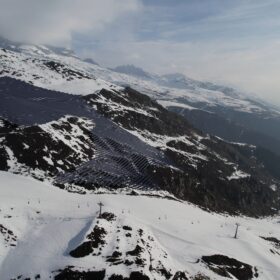
Alpine solar for ski areas
Energy company Axpo wants to build a 10 MW solar plant on an 80,000 m2 surface at an altitude of 2,100 in the Swiss Alps. The Ovra Solara Magriel project will provide power to the mountain railway and a ski area.
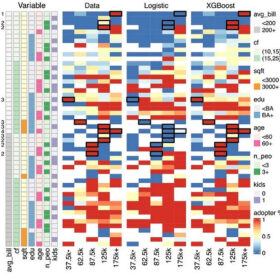
Machine learning method to identify residential PV adopters, reduce soft costs
Researchers have defined a new machine learning-based methodology that reportedly reduces customer acquisition costs by about 15% or $0.07/Watt. It is based on an adapted version of the XGBoost algorithm and considers factors such as summer bills, household income, and homeowner’s age, among others.
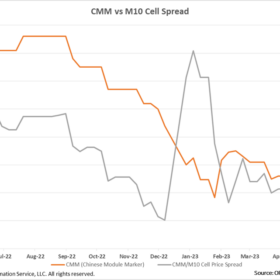
Solar module prices remain at 13-week low, spread against M10 cell narrows from January high
In a new weekly update for pv magazine, OPIS, a Dow Jones company, provides a quick look at the main price trends in the global PV industry.
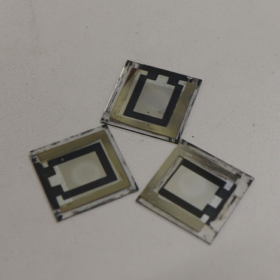
Inverted perovskite solar cell achieves 24.8% efficiency via new additive
The additive consists of a molecule known as 4-guanidinobenzoic acid hydrochloride (GBAC), which is a raw material and intermediate commonly utilized in organic synthesis, pharmaceuticals, agrochemicals and dyestuff fields. The solar cell has a p–i–n structure and, thanks to the new additive, showed considerably reduced defect density on the perovskite film, which in turn results in reduced non-radiative recombinations.
