
Bahrain launches 3 MW rooftop tender
The procurement covers 66 government buildings identified by the nation’s solar unit from a 120-building portfolio. Successful bidders will sign a PPA with the government, which is aiming at self-consumption with an element of net-metering.
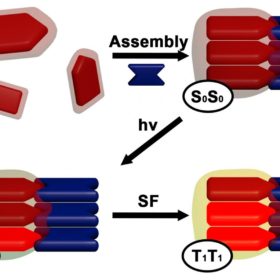
Singlet fission may raise theoretical efficiency of solar cells to 44%
According to a U.S. research team, new nanomaterials relying on dyes based on diketopyrrolopyrrole and rylene can generate a singlet fission reaction that extends the life of harvestable electronic charges.
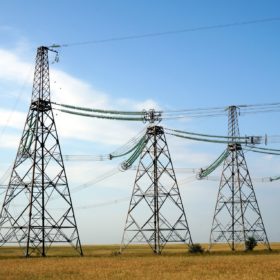
Risen Energy completes 40 MW solar project in Kazakhstan
Since 2012, Kazakhstan has shown increased interest in its energy transition and put in place supportive regulations. The country lies in the path of China’s ‘One Belt, One Road’ initiative, which unlocks large-scale infrastructure investments.
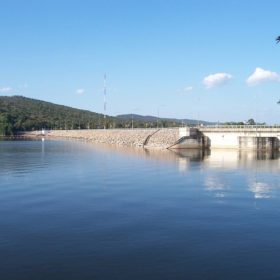
Thai utility EGAT plans 69 MW of floating PV projects
Floating plants with capacities of 45 MW and 24 MW have been announced by Thailand’s largest power provider. They may be the first of nine projects at dams operated by the utility.
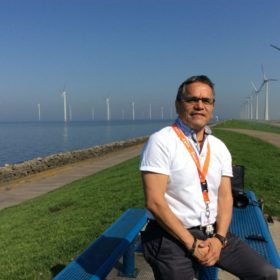
pv magazine’s Mexican editor Jorge Zarco wins journalism prize
The editor-in-chief of pv magazine Mexico won first prize in the interview category at this year’s Solar Energy Journalism Awards, organized by the Mexican Solar Energy Association.

Debunking the low-cost nuclear myth
An article published in the FT this week was right to point out that pricing new energy capacity involves more than just comparing strike prices, but if you are in the business of calculating real costs, do it properly. For nuclear in particular, that’s a case of ‘in for a penny, in for (several) pounds’.

Italian renewables fund targets €250m more investment by 2021
The acquisition of an 85 MW, three-project solar portfolio by the Tages Helios fund illustrates the confidence investors have in Italian renewables, and fund managers are optimistic about the sector as they bid to expand into wind power as well as PV.
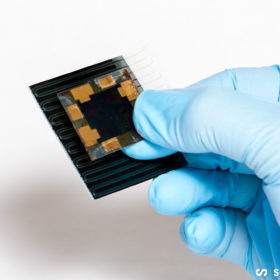
Solliance claims 21.5% efficiency for perovskite CIGS cell
The European solar research organization, Solliance announced it has achieved a 21.5% efficiency for a flexible copper indium gallium selenide (CIGS) tandem solar cell based on perovskite.
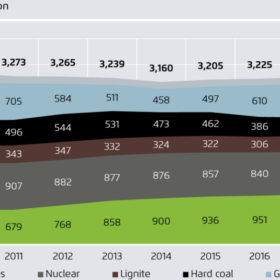
EU solar demand to reach 30 GW in 2022
According to a new report from Agora Energiewende and Sandbag, the EU solar market grew around 60%, or 10 GW, last year. The analysis also predicts that total solar demand across all EU PV markets will continue to grow due to lower module prices, and that it may reach an annual volume of 30 GW within four years. Meanwhile, solar has reportedly achieved a 4% share in the EU electricity mix.

‘China’s most efficient’: Hanergy hits 24.34% efficiency on HJT cell
Chinese PV manufacturer Hanergy Thin Film Power Group today announced it has achieved 24.23% cell efficiency using its silicon heterojunction technology. The efficiency has been confirmed by Japan’s Electrical Safety & Environment Technology Laboratories.
