Poland cancels solar auction for projects exceeding 1 MW
The Polish government said the auction was cancelled due to some adjustments relating the EU state aid rules that must be done in the legislation for renewables.

Canada’s Nova Scotia launches program for community solar
Canada’s second smallest province, Nova Scotia, has announced the launch of the Community Buildings Pilot Program, an initiative that is expected to spur the development of community solar projects throughout the region.
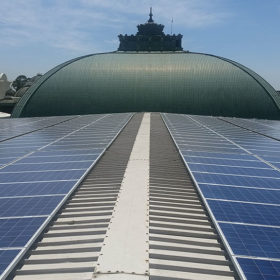
South Africa exempts IPPs up to 1 MW from licensing
Under the new rules, unlicensed PV installations not exceeding 1 MW may provide with power a final client or be used for self-consumption.
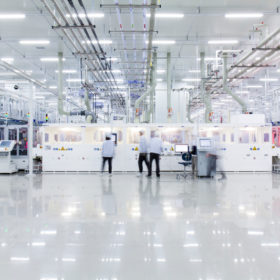
Hanwha QCells to locate Turkish panel factory in Ankara due to earthquake risks
pv magazine has learned that Hanwha QCells has started the construction of its Turkish panel factory, which the company decided to locate in the country’s capital city Ankara due to earthquake risks. The decision opens the debate about nuclear safety in Turkey even more powerfully.

Elgin Energy seeks permission to build 25 MW solar farm in Kilkenny, Ireland
Continued tumbling cost of solar prompts Elgin Energy to apply for planning permission to build a large-scale solar farm on a 100-acre site in Kilkenny, Ireland.
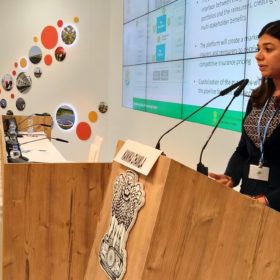
ISA presents risk mitigation feasibility study for pilot 20 GW capacity
The International Solar Alliance (ISA) presents its first offering, a Common Risk Mitigation Mechanism (CRMM) feasibility study, at COP23 in Bonn, Germany, to deepen solar markets, which aims to mobilize up to $1trn of capital investment by 2030.
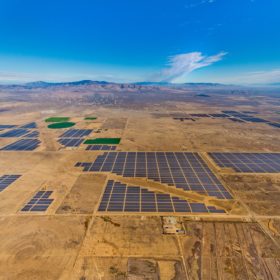
IEA: Solar PV set to lead capacity additions to 2040
In its annual flagship report, the International Energy Agency (IEA) highlights that fast-declining costs will turn solar into the cheapest source of new energy generation over the next 25 year.
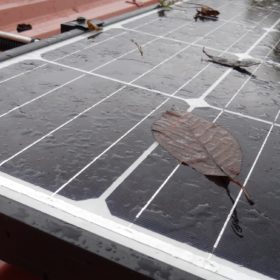
What happens when… insulation fails?
Series troubleshooting: Individual insulation failures are often difficult to detect in monitoring. And when such problems are suspected, it is an additional challenge to pinpoint them precisely. In this series of realistic cases, pv magazine aims to make the estimation of troubleshooting efforts more concrete and to stimulate a discussion on today’s troubleshooting efficiency.
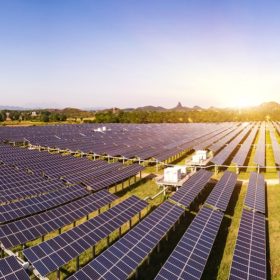
UK & Germany on course for 50% renewables by mid 2020s, finds BNEF report
Study carried out by Bloomberg New Energy Finance on behalf of Eaton and U.K.’s Renewable Energy Association finds economic drivers key to increased uptake in solar and wind, although back-up capacity required by 2040 likely to be similar to today’s levels.
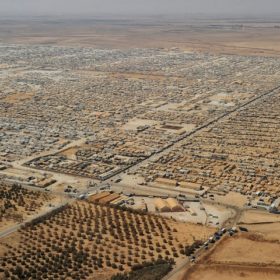
Jordan connects 12.9 MW PV plant located at refugee camp
Array at the Zaatari refugee camp on border between Jordan and Syria is world’s largest solar plant located within an official refugee camp, the UN says. Facility meets power needs of nearly 80,000 displaced Syrians.
