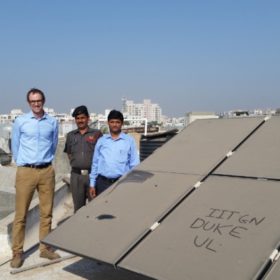
ADB proposes new approaches to financing energy projects
Governments of cash-strapped developing nations should start exploring a range of innovative financing solutions to support the development of environment-focused infrastructure projects such as financially bankable solar installations, the Asian Development Bank (ADB) says in a new report.
Hareon posts $76.07 million net loss in H1
Hareon Solar Technology has reported a net loss of CNY 501.5 million ($76.07 million) in the first half of 2017.
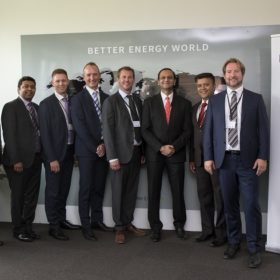
Denmark’s Better Energy signs solar partnerships with Tata Power Solar and Huawei
The Danish renewable energy developer partners with the Indian solar energy company for the supply of solar modules, as well as China’s Huawei for the its inverter solutions.

Future PV: The feasibility of solar-powered hydrogen production
There is a solid business case to combine PV plants with electrolyzers, as generation costs are low enough to competitively produce hydrogen as a fuel, says Bjørn Simonsen of NEL Hydrogen. He will speak at pv magazine’s Future PV event at SPI in Las Vegas.

Efficient PPAs may propel solar-diesel micro-grid deployment , says study
In terms of micro-grids, key to reducing diesel consumption by renewables are efficient PPAs, finds consultancy THEnergy, noting that the complexity of these contracts is much greater than in the case of grid-connected photovoltaic systems.
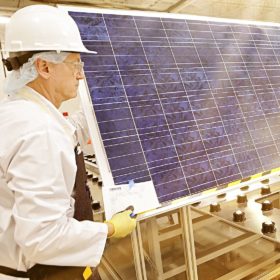
Canadian Solar connects 27.3 MW PV plant in Japan
Module manufacturing heavyweight Canadian Solar today announced the start of commercial operation on a 27.3 MW PV power plant in Tottori Prefecture, Japan.
Huadian Power posts $27.5 million H1 loss
Huadian Power International (HPI) has recorded a loss attributable to shareholders of CNY 181 million ($27.5 million) in the first half, despite revenue of CNY 36,423 million, up 24% year on year.
Perovskite has changed its status to single (cell)
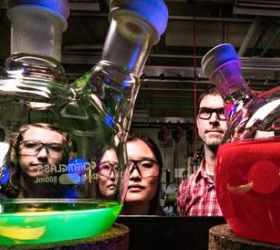
In another breakthrough for the material so many solar advocates hope will replace traditional silicon in module production, a group of scientists in China and the United States have produced the first monocrystalline perovskite cell, which could accelerate its acceptance as a silicon replacement.

BECE posts $81.3 million profit in H1
Beijing Enterprises Clean Energy (BECE) reported an unaudited profit of HK$636 million ($81.3 million) for the first half of 2017, from just HK$71.4 million a year earlier, as it connected roughly 210 MW of new solar capacity to the grid in China.

U.S Researchers look to plant photosynthesis to improve solar efficiency
A team of scientists at Georgia State University has discovered a process that occurs naturally in plants. Known as ‘inverted-region electron transfer’, better understanding of this process could contribute to the design of higher efficiency solar cells, says the University.
