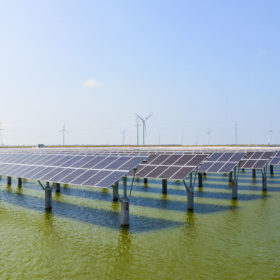
Energy Watch Group: 100% renewable electricity is both feasible and cost effective
A joint study by Finland’s Lappeenranta University of Technology and Energy Watch Group presented on the sidelines of the COP23 talks in Bonn demonstrates that a global transition to 100% renewable electricity could be achieved by 2050, and would be more cost effective than the current electricity system.
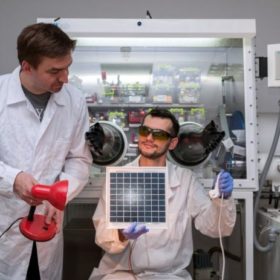
Scientists grind out solvent free perovskite thin-film process
Researchers from the Institute of Physics of the Polish Academy of Sciences (PAS) and the renowned Ecole Polytechnique Federale de Lausanne (EPFL) have collaborated on a new technique for the creation of perovskite solar cell materials. The technique replaces traditional solvent based processes with steel ball mill grinding.
Tongwei to invest $1.8bn to build two 10 GW solar cell factories in China
Massive 12 billion yuan ($1.8 billion) investment part of Chinese solar firm’s goal to boost its production capacity to 30 GW and become world’s largest solar manufacturer.

Enphase Energy narrows Q3 losses to $7m, records sequential revenue increase
The U.S. microinverter specialist posted losses of $6.9 million in the third quarter but did manage to increase its revenue sequentially by 3% to $77 million.
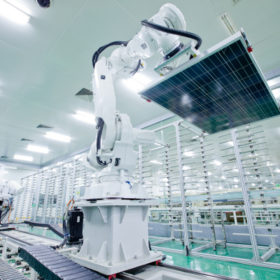
JinkoSolar sets new mono-PERC cell efficiency record
JinkoSolar has achieved yet another efficiency world record, hitting 23.45% with its p-type monocrystalline PERC cell technology. The record has been confirmed by the Chinese Academy of Sciences.
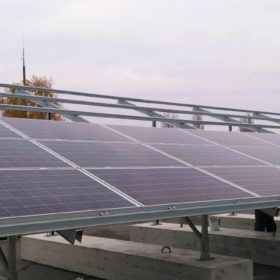
Construction underway on first PV array for Chernobyl
Project developer Rodina today announced that construction is underway on the first solar power plant to be built on land inside the Chernobyl exclusion zone.

“Smart” greenhouses can grow plants while generating electricity
A new type of greenhouse with special PV modules installed, which absorbs some light, while allowing some to pass through to allow photosynthesis has been tested by researchers at the university of California with very positive results.
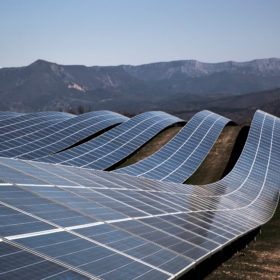
Siemens to equip 140 MW projects in Brazil, Pakistan
The German technology firm has bagged orders for the turnkey electrical equipment and installation of two solar farms in Brazil and Pakistan. In addition, it announced the end of its cooperation with German inverter specialist SMA by the year’s end, and plans to manufacture its own inverters.
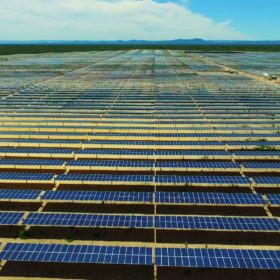
Clean energy investment by non-OECD countries fell $40bn in 2016, but developed nations also slacking, finds BNEF
While China accounted for three-quarters of the investment reduction in clean energy in 2016, other non-OECD countries spent 25% less on renewables last year compared to 2015, according to BNEF and Climatescope data. 2009’s Copenhagen pledge by richer countries to support developing world also falling short.

Digital technologies in energy to reach to $64 bn by 2025, BNEF reports
Energy innovations will be centered on digital technologies and the strategic use of data, with focus shifting from fossil fuel operation and maintenance to distributed renewables and the connected home, reads a BNEF report, adding that the market size for digital technology in energy will grow to $64 billion by 2025.
