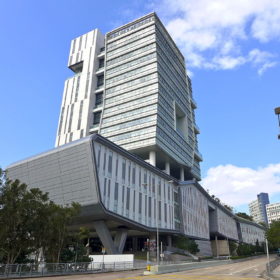
All-inorganic perovskite solar cell hits 16.1% efficiency
Researchers from the City University of Hong Kong have developed an all-inorganic perovskite cell with an electron-pair donor which offers a pair of non-bonding electrons. The cell was developed by applying that ‘Lewis base’ small molecule to passivate the inorganic perovskite film.
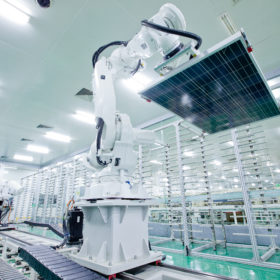
Jinko claims two more efficiency records for bifacial panels
The Chinese manufacturer has achieved conversion efficiencies of 21.82% and 22.49% for its p-type PERC and n-type HOT bifacial panels, respectively. The results were confirmed by Germany’s TÜV Rheinland.

Panda Green showcases its full portfolio
The embattled developer today published what appears to be a sales pitch as it seeks urgent investors ahead of an eight-day debt deadline.

Solargiga hits 10% revenue rise – on back of 48% more shipments
The Chinese manufacturer had to ship a lot more ingots, wafers, cells and modules to secure a modest rise in returns, according to its unaudited 2019 figures.
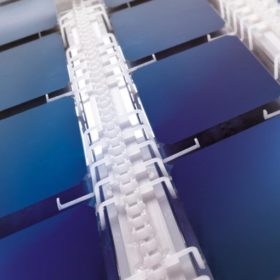
Singulus scores €50m CIGS production kit order from unit of China’s CNBM
The German PV equipment provider has agreed to supply manufacturing equipment for CIGS thin-film solar panels to the CNBM Bengbu Design and Research Institute for Glass Industry, a subsidiary of cement producer China National Building Material.

State-owned entity delays Panda Green bail-out in wake of debt restructure setback
Panda Green today said delays acquiring the necessary approvals were responsible for holding up its critical HK$1.79 billion lifeline but the deadline for completion had originally been put back to coincide with publication of the results of a debt restructuring proposal which ultimately tempted less than a third of note holders.

Abu Dhabi fund approves $105m for clean energy projects
The Abu Dhabi Fund for Development will support half a dozen megawatt scale projects featuring solar in the Caribbean and Africa. In addition to around 42.5 MW of new solar capacity, the fund will also back the development of energy storage, waste-to-energy and biogas facilities.
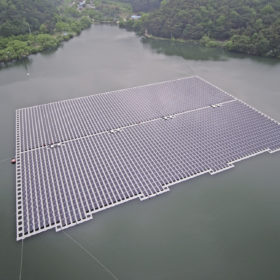
Masdar to install 145 MW of floating PV in Indonesia
Abu Dhabi-based renewable energy group Masdar is sailing into the Southeast Asian solar market with Indonesia’s first floating solar project. The petro-state owned developer says the facility will be the largest in the region.
Panda Green’s hopes of postponing debt are dashed
The heavily-indebted, Chinese state-owned solar project developer now has ten days to rustle up $242 million after a debt restructuring proposal was accepted by less than a third of its creditors.

South Korean government reassures domestic PV industry
The country’s Ministry of Trade, Industry and Energy (MOTIE) has provided new market share figures for the domestic PV sector that contradict recent media claims that Chinese manufacturers have been aggressively ramping up their local presence at the expense of Korean module makers. The government has also confirmed plans to prioritize PV projects made with low-carbon, high-efficiency modules.
