New renewables cheaper than legacy coal or gas for almost half the world’s population
Electricity bill payers in nations as diverse as Germany, Greece, India and China should be aware new solar projects can now generate electricity cheaper for them than legacy coal and gas-fired plants.
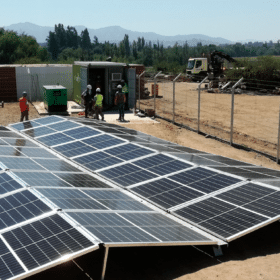
Plug-and-play mobile PV system to power solar parks’ construction sites
A Spanish renewable energy company has installed its first, pilot mobile PV unit at a new detention center in Chile.
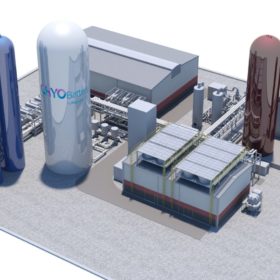
Latin America’s first liquid air storage project
The 50 MW Highview Enlasa project will be located in Diego de Almagro, in Chile’s Atacama Region.

IEA highlights solar’s dependence on Chinese copper processing
The sheer volume of new power lines which will be required to accommodate the rising tide of solar installations ensures copper has been included by the International Energy Agency on its list of minerals which must keep flowing if the energy transition is to stay on course. And it’s not production that’s the potential bottleneck.
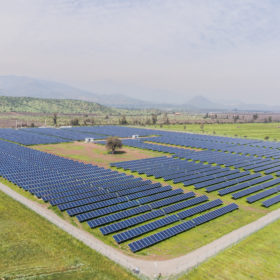
Another 2 GW of solar under review in Chile
The Chilean environmental authorities are currently scrutinizing the projects Solar La Pampina (160 MW), Gabriela (220 MW), Ghungnam Kcs (709 MW of PV and 300 MW of CSP), Pelequén (175 MWp), and Planta Solar Sol del Loa (640 MW).

Botswana tops list of world’s ‘super abundant’ renewables nations
A Carbon Tracker report estimates 60% of the world’s technical solar potential – enough to produce 3.5 exawatt-hours of clean electricity per year – would already be cheaper than fossil fuel if installed. Of the remainder, most would be in sub-Saharan Africa, a region which has the potential to be a global solar and wind powerhouse.

China’s Covid recovery saw green bond issuance rebound in second half of 2020
The $18bn worth of sustainable finance instruments floated in the nation last year marked a retreat from previous highs but, with most of the bonds issued from July onwards, the recovery is under way, according to the IFC, which is anticipating a more-than-$100 billion sector in emerging markets over the next three years.
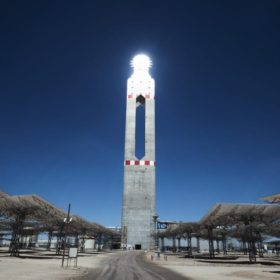
Latin America’s first CSP plant now online
A consortium led by Abengoa and Acciona has commissioned a 110 MW concentrated solar power project, paired with 100 MW of PV, in Chile’s Atacama Desert.
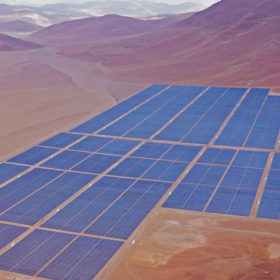
Chile’s cumulative PV installations hit 4.6 GW
New statistics from ACERA, the Chilean renewable energy association, show that solar covered around 12.9% of the country’s total electricity demand in March.
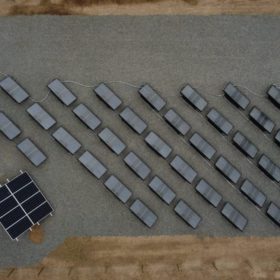
Chilean startup using PV to produce potable water from humidity
A Chilean startup is using solar energy to produce high-quality drinking water from the humidity in the air. The first plant is located in Chile, but there are plans in the works to expand to Colombia and Peru.
