Webinar Q&A: A recipe for improved performance
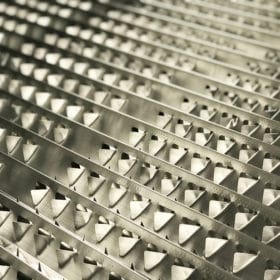
In a recent pv magazine webinar, module degradation experts took our audience through the role of temperature and mechanical stress in causing modules to under-perform. We were treated to a look at some impressive results for modules integrated with Coolback – a solution that replaces the backsheet/rear glass and frame in a conventional panel and promises lower operating temperatures and better mechanical strength. Here, Simon Meijer and Alex Masolin, from Coolback – along with Fraunhofer ISE’s Andreas Beinert – answer some of the questions we didn’t have time for during the live broadcast.
Offshore floating PV platform unveiled in the Netherlands
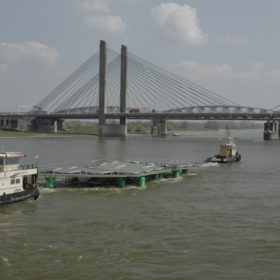
Dutch floating structure specialist Solarduck has built a pilot 65 kW floating PV array that will be connected to a 10 kW electrolyzer to produce hydrogen bonded with a liquid organic hydrogen carrier. The system is relying on the company’s proprietary floating technology that resembles an offshore oil platform.
Electric cars to store renewables in the Netherlands
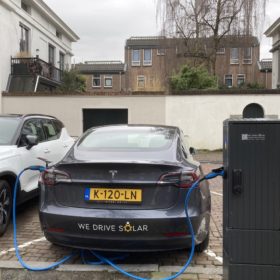
We Drive Solar and Hyundai are planning to set up a network of 500 bi-directional EV recharging stations in the city and region of Utrecht. Through this technology, electric cars may contribute to the storage of renewable energy in a country affected by grid constraints.

Silicon carbide passivating contact for 24%-efficient crystalline solar cells
The special passivating contact is claimed to feature high transparency, good conductivity, and at the same time, to offer enough hydrogenation for passivation. The cell built with this contact achieved an open-circuit voltage of 725 mV, a short-circuit current density of 40.87 mA cm−2, and a fill factor of 80.9%. Its certified efficiency was 23.99%.
Massive plan for hybrid heat pump deployment in the Netherlands
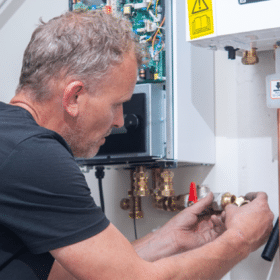
The Dutch association of national-regional electricity and gas network operators, Netbeheer Nederland, is leading a plan to deploy up to 2 million hybrid heat pumps by 2030. The plan should be supported by a subsidy scheme by the government and enable the installation of at least 100,000 heat pumps per year from 2024.
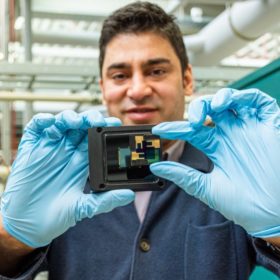
Solliance hits 28.7% efficiency on perovskite/silicon tandem solar cell
The Dutch consortium has achieved the record result by combining, in a four-terminal tandem configuration, an 18.6% efficient highly near-infrared transparent perovskite with a prototype of a c-Si interdigitated back contact (IBC) silicon heteroJunction (SHJ) cell developed by Japanese electronics manufacturer Panasonic. The perovskite cell was also combined with other kinds of solar cells and other remarkable record efficiencies were hit.
Big modules, bigger ballast? – New safety considerations for the rooftop sector
Join this webinar and learn more about wind effects on big modules, aerodynamic testing, structure codes, and how to ensure your next project is safe.
Model agreement to make solar and wind share same connection point in the Netherlands
The model agreement was outlined by Dutch consultancy Ventolines B.V. and follows the introduction of new provisions for the sharing of the same connection point issued by the country’s government last year.
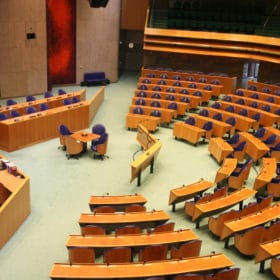
Debate on alleged forced labor in Chinese PV industry heats up in the Netherlands
Three Dutch political parties have brought the forced labor issue to Parliament and have asked the Minister for Foreign Trade and Development Cooperation, Sigrid Kaad, to report on the matter.
Solar changing shape of electricity prices in Northern Europe
Rising volumes of photovoltaic project capacity are increasing the incidence of negative price periods for electricity–and changing the times of day when they occur.
