Solar-plus-storage will start to make big inroads in the year ahead
By this time next year we may be able to wave goodbye to that old chestnut about renewables endangering security of supply. Elsewhere, the price of lithium – and the products it goes into – could go either way after tanking this year.

The year in solar, part IV: More storage and hydrogen advances as solar just kept getting cheaper
Battery innovations started to come thick and fast this quarter as the hunt for alternatives to lithium-ion intensified and the latest slew of solar tenders indicated the relentless pressure on solar power generation costs was showing no sign of abating.

The year in solar, part II: A lively show season, more legal shenanigans and rising panel efficiencies abound
Intersolar Europe is always a key date in the solar calendar but this year’s show had it all, including three panel-smuggling arrests. Elsewhere, wafers were getting bigger, efficiency records were tumbling and new technologies were emerging. There was also more news on the solar car ports fad and Hanwha’s ongoing legal tussle.

The year in solar, part I: New modules, flat-pack solar and inverter turbulence
The first part of pv magazine’s review of 2019 considers Q1, when solar early adopter Italy offered an optimistic start to the year by fleshing out its plans for PV but uncertainty still clouded the world’s biggest solar market. The potential for household solar installations to rocket the world over – helped by ever cheaper panels – prompted strategic decisions in the inverter market and analyst expectations were confounded as the cobalt and lithium price plummeted, bringing the EV revolution a big step nearer.
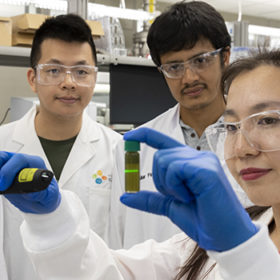
Tungsten disulfide helps organic solar cell reach 17% efficiency
Researchers from Saudi Arabia’s King Abdullah University of Science and Technology claim to have developed a highly performant organic PV cell using tungsten disulfide flakes a few atoms thick. The stability of the device, however, is still to be evaluated.
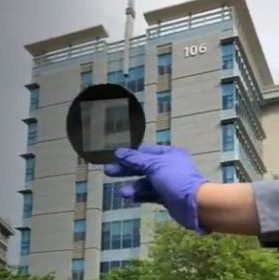
New transparent solar cell for window applications
South Korean scientists have transformed an opaque crystalline silicon solar cell into a transparent one by punching holes into it measuring around 100 μm in diameter. A neutral-colored, transparent c-Si substrate was used to develop the new cell, which is said to have an efficiency of up to 12.2%.
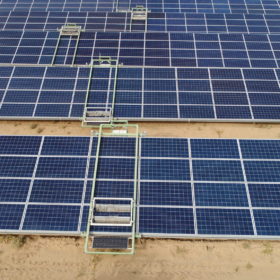
ReNew Power, South Korea’s GS E&C to build 300 MW of PV in India
The Indian developer will hold a 51% stake in the venture, with Seoul-based GS E&C taking the remainder. The capacity was awarded under Solar Energy Corp. of India’s tranche-IV auction earlier this year.
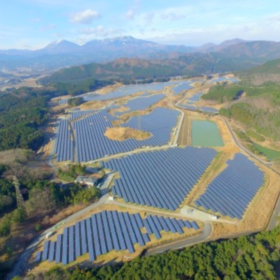
Pacifico Energy raises $265.6m with new PV investment fund, picks up 35 MW project in Japan
The Tokyo-based renewables developer has successfully launched its second solar investment fund, which will include roughly 216 MW (DC) of solar capacity across five sites in Japan.

Renesola exits Vietnam, India and Korea
The Shanghai-based project developer – which will soon relocate to the U.S. – says the profit margins are not high enough in those markets and has cancelled its project pipeline in the nations. The company has also changed its CEO after less than five months and is on a drive to reduce capital costs.
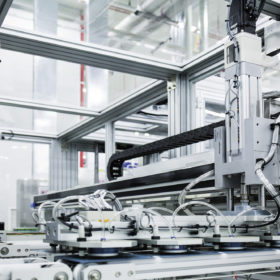
South Korea’s roadmap to drive down solar costs
The government has unveiled a plan to help the PV industry reduce the cost of solar panels from around $0.23/W to $0.10/W by 2030. The plan also aims to reach module efficiencies of around 24% – up to 35% for multi-junction cells – by the end of the next decade.
