
Wafer producers scramble to stay afloat despite hydropower advantage
In a new weekly update for pv magazine, OPIS, a Dow Jones company, reports that FOB China wafer prices remained stable this week amid weak demand and low production. It says manufacturers continue to face margin pressure despite seasonal hydropower cost relief and traceability documentation premiums.

Polysilicon glut may reverse into shortage by 2028, says Bernreuter
China’s polysilicon capacity hit 3.25 million metric tons (MT) in 2024, driving global prices below $4.50/kg, says Bernreuter Research. The Germany-based market analytics firm warns the market could swing to a shortage by 2028 if capacity cuts overshoot.
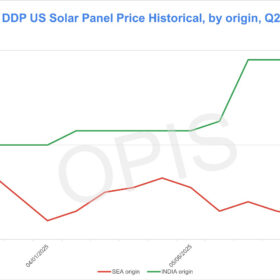
US panel price spread widens between India and Indonesia/Laos origin
In a new weekly update for pv magazine, OPIS, a Dow Jones company, reports that US-assembled modules with imported cells continue to be heard between $0.26/W and $0.33/W, while modules with domestic content – which are still limited to just a handful of producers – are generally quoted between $0.4/W and $0.5/W.
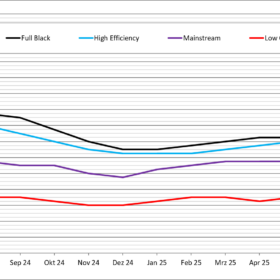
Solar module prices falling with no clear trend in sight
Solar module prices in Europe have fallen by up to €0.01 ($0.01)/W this month, according to pvXchange.com, as the PV market shows resilience amid policy uncertainty and geopolitical risks.

Abandoned coalmines could host 10% of global solar capacity
A survey of mines closed since 2020 and those planned to close by 2030 present an opportunity for installing nearly 300 GW solar on already-developed lands, finds a report from Global Energy Monitor.

Understanding P50, P90 and P99 in solar energy
A review of using statistical probability to understand solar production outcomes.
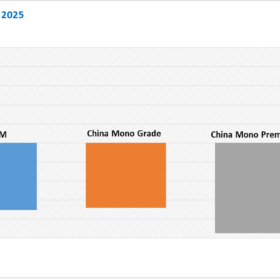
China polysilicon prices fall 11.76% since early April peak
In a new weekly update for pv magazine, OPIS, a Dow Jones company, reports thatglobal polysilicon negotiations remain challenging, as buyers and sellers continue to struggle to reach agreements on pricing amid a persistent supply-demand imbalance. Furthermore, it reveals that China’s polysilicon futures market could imply a further 13% drop for Nov 2025 delivery contracts.

Cybersecurity as a powerful tool to enable resilient energy storage projects
Compliance with ever-increasing cybersecurity regulations is a challenge for many in the energy storage industry but it creates big opportunities for risk-mitigation. Katherine Hutton and Lars Stephan, from energy storage integrator Fluence, take a closer look at cybersecurity compliance risks and how investors can mitigate revenue losses with a clear strategy.
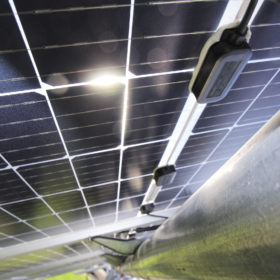
Global solar tracker shipments reach 111 GW in 2024
The United States continues to dominate the solar tracker market, with Nextracker securing the top spot globally in 2024.
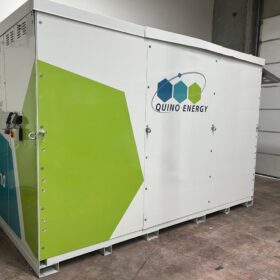
How organic flow batteries could erase the need for critical-mineral dependency
Vanadium flow and lithium-ion batteries both require materials described as critical by the US Department of Energy (DOE).
