
Romania re-introduces PPAs to attract investors
The Romanian government has decided to re-introduce directly negotiated Power Purchase Agreements (PPAs) to boost investment in its renewables sector, but only projects commissioned after June 1, 2020 will be eligible.

UK could see 900 MW of solar compete in subsidy round planned next year
Analyst Cornwall Insight said the figure, drawn from its Renewable Pipeline tracker, related only to the proportion of the nation’s 13 GW solar pipeline which had already applied for or secured planning permission.
UK includes solar in new generation capacity auction
The announcement by the Department for Business, Energy and Industrial Strategy of an auction which will include solar next year appears to back prime minister Boris Johnson’s claims to be serious about the nation’s net-zero carbon ambition.

Unrealistic price signals and an explosion of tenders hinder African PV
French thinktank the Institut Montaigne says Africa is absent from the global solar revolution for several reasons including a lack of suitable financing tools, the small size of projects and a systematic recourse to tendering. Removing artificial price signals set by ever more competitive tenders could be a step towards a more mature market, ready for large scale solar tenders.

UK’s Labour announces plans for 22 GW of new solar capacity by 2030
Although PV trails wind and nuclear in terms of its anticipated future footprint, the opposition party’s attempt to outflank left of center rivals on climate change has resulted in one of the world’s most ambitious national roadmaps towards a zero-carbon future.

Recovering interest rates may raise large scale solar electric price 11%
Renewables investment may by hit by rising interest rates despite the falling cost of clean energy tech just as fossil fuels avoid the impact of rising base rates.
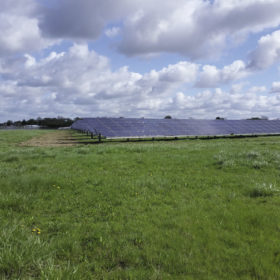
Large scale PV moribund in UK but unsubsidized projects offer hope
The latest government figures show utility scale solar had near-zero growth in 12 months. Although excluded from the Contracts for Difference procurement regime, large scale projects may experience a resurgence thanks to unsubsidized schemes linked to bilateral power supply deals, with the Solar Trade Association predicting 400 MW of such projects may be finalized this year.
UK Government: ‘The devil is in the details’ for allowing RE in Capacity Market
A conference held this week in London shed light on the U.K. Government’s timeline for reviewing its Capacity Market and Contracts for Difference schemes, and what the changes could mean for renewable – and specifically solar PV – energy projects.
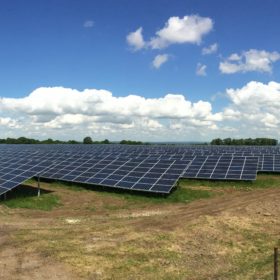
Official statistics illustrate UK solar market’s sluggish growth
Despite a remarkable cumulative PV capacity of over 12.8 GW, newly registered PV systems in the first four months of this year amounted to a disappointing 72 MW. The U.K. Solar Trade Association does not expect the current poor growth trend to improve unless the government provides more regulatory certainty.
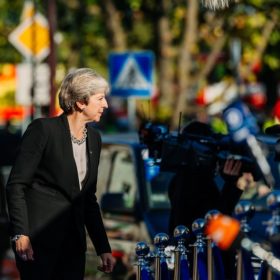
Clean Growth Strategy: has solar become a dirty word for UK government?
The £2.5 billion Clean Growth Strategy makes no direct mention of solar power, despite explicitly laying out support for numerous policies that will rely – directly or indirectly – on the presence of PV, such as EV charging, property retrofits and green mortgages.
