Tongwei to invest $1.8bn to build two 10 GW solar cell factories in China
Massive 12 billion yuan ($1.8 billion) investment part of Chinese solar firm’s goal to boost its production capacity to 30 GW and become world’s largest solar manufacturer.
Clean energy investment by non-OECD countries fell $40bn in 2016, but developed nations also slacking, finds BNEF
While China accounted for three-quarters of the investment reduction in clean energy in 2016, other non-OECD countries spent 25% less on renewables last year compared to 2015, according to BNEF and Climatescope data. 2009’s Copenhagen pledge by richer countries to support developing world also falling short.
Yingli to supply 38 MW in China
Yingli Solar has agreed to supply PV modules for 38.4 MW of solar capacity that is being built under China’s PV poverty alleviation program.
Equis Energy snapped up by GIP in record $5bn renewables deal
The Singapore-based renewable energy developer has agreed to be sold to investment fund Global Infrastructure Partners. China Investment Corp, Canada’s PSP Investments and other co-investors are also involved in the deal, which is the largest yet seen for the renewable energy industry.
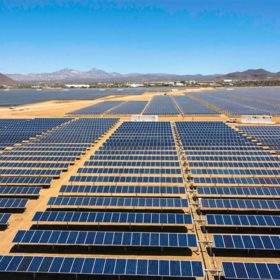
Global solar market to grow 30% and reach close to 100 GW this year, says Bernreuter Research
The German-based analyst and polysilicon specialist believes that newly installed solar PV capacity will hit 95 GW in 2017 and could hit 100 GW. Polysilicon spot prices set to fall by end of year.
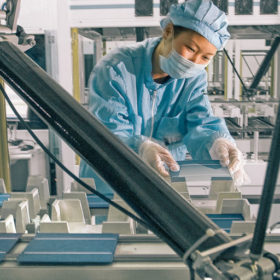
China still needs to step up renewable adoption to meet Paris target, report finds
Report by the China National Renewable Energy Centre (CNREC) and the Energy Research Institute of Academy of Macroeconomic Research urges China to increase the pace of development of its Renewables Energy infrastructure.
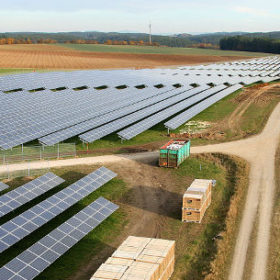
Solar fastest growing energy source in 2016, finds latest IEA report
The International Energy Agency’s Renewables 2017 report finds that solar PV capacity grew 50% last year, underpinning a 12% increase in this year’s renewables forecast and prompting the IEA to forecast 1,000 GW of clean energy by 2022.
Solargiga invests $52.8m in new China ingot and wafer fab
Solargiga is ramping up its production capacity for monocrystalline silicon ingot and monocrystalline silicon wafers at a new factory in Quijing, China. Expansion undertaken alongside subsidiary Jinzhou Yangguang Energy.

EU nears decision on new minimum price rules
The European Commission aims to introduce a new procedure for determining the minimum import price for Chinese PV panels, after member states have discussed the proposal. It still remains unclear if the minimum import price for solar modules was lowered at the beginning of September or it will be reduced by two cents per watt in October.
Korean Peninsula tensions having little impact on solar relations with China, says analyst
Despite reports suggesting China’s anger at South Korea’s deployment of anti-missile defense systems has aggravated a slump in Korean solar imports, analysis of import data shows this not to be the case.
