
New passive solar module cooling tech based on lightweight hydrogel
Researchers at Thailand’s Vidyasirimedhi Institute of Science and Technology demonstrated a novel hydrogel that has high cooling effect on silicon PV panels. The lightweight technology purportedly enables a temperature drop of 23 C, from 70 to 47 C, and a relative 12.3% power conversion efficiency increase.

Hygroscopic hydrogel may increase solar module yield by 2.1%
Researchers in China have found that a special type of hygroscopic hydrogel made of the polyacrylamide polymer and lithium chloride may reduce PV module temperature by up to 7.5%. They have also developed a mathematical model to analyze the operational mechanisms and factors responsible for the cooling performance.

Rectangular wing vortex generators for solar module cooling
University of New South Wales researchers have created vortex generators that can reportedly reduce the operating solar module temperature by up to 2.5 C. They built two different prototypes, based on aluminum and a conductive 3D printable polymer, and tested them under several scenarios in an experimental setting deployed in Sydney.

Using air conditioning to cool down PV modules, dry dishes
An international research team has investigated how air conditioning may be used to reduce the operating temperature of PV panels. The researchers not only found that the proposed approach is technically viable, but they also tested the use of excess heat from the panels for drying dishes.
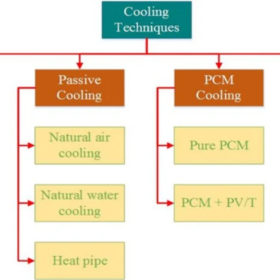
PV module cooling techniques at a glance
Egyptian researchers have analyzed all cooling techniques for solar module cooling. Their review includes passive and active cooling methods, cooling with phase change materials (PCMs), and cooling with PCM and other additives, such as nanoparticles or porous metal.
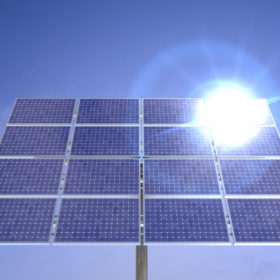
The best PV module cooling technique
An international research team has analyzed all existing cooling technologies for PV panels and has indicated the current best options and future trends of research. According to its findings, active water cooling, although expensive and not particularly practical, is the most effective cooling technique while passive cooling systems, despite being easy to apply, have still limited possibilities.

Wind direction and tilt angle approach to keeping panels cool
A technique proposed by scientists in the United Stated could raise solar plant output 5% and decrease panel degradation by more than 0.3% per year, according to the researchers. The approach is based on wind direction and speed, and module inclination.
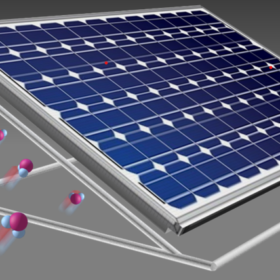
Harvesting atmospheric water to cool down PV panels
Scientists from Saudi Arabia have proposed a new PV panel cooling technique which employs an atmospheric water harvester. The device uses waste heat from the PV panel to collect atmospheric water at night and then releases it during the day to cool down the module. The researchers claim the device may also be improved to produce liquid water, which could be used for the cleaning of the modules.
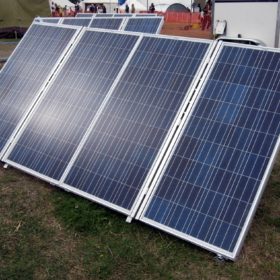
A new technique for cooling solar panels
Scientists in Egypt have investigated the effectiveness of using water and a mixture of aluminum oxide and calcium chloride hexahydrate to cool PV modules. Optimal performance was observed with a solution of 75% water, according to the research findings.
