
Cooling PV inverters with skived fin heat sink
Researchers in Turkey tested a novel heat sink design to cool insulated gate bipolar transistor (IGBT) arrays in solar inverters. They found that it reduced module temperatures by more than 6 C in lab experiments.
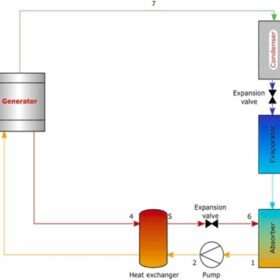
PV-driven absorption cooling system for arid regions
Scientists in Saudi Arabia have simulated a solar-powered single-effect absorption cooling system that uses water-lithium bromide as a working fluid, under the environmental conditions of Riyadh. Exergy and exergy rates are calculated for each level of the system, with optimal generator performance being found to peak at 80 C.
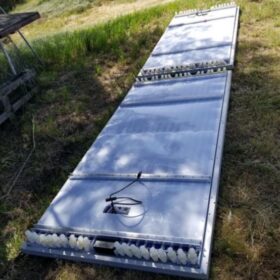
Canadian startup secures patent for solar module cooling tech
Enertopia has developed a solar module cooling system that uses a moisture collection layer to transfer heat while capturing water for irrigation in arid regions. The design channels heat from the panel to a liquid transfer system, improving efficiency and water use.
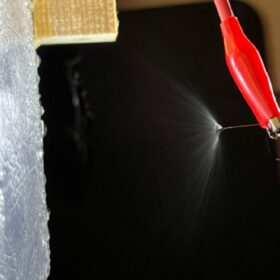
Reducing solar module temperature via electrospray cooling
Scientists in Turkey have sought to use electrospray cooling to reduce the operating temperature of photovoltaic for the first time. They said their experiments offer promising results for the potential application of this technique in real PV systems.
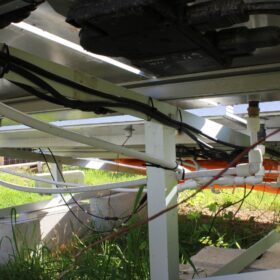
PV module cooling tech based on water chamber
Scientists in Malta have created an after-market cooling solution that can be fitted to existing standard PV modules. The system is based on a water chamber placed at the backside of the module and can reportedly provide a net electrical energy gain of more than 9%.

Rectangular wing vortex generators for solar module cooling
University of New South Wales researchers have created vortex generators that can reportedly reduce the operating solar module temperature by up to 2.5 C. They built two different prototypes, based on aluminum and a conductive 3D printable polymer, and tested them under several scenarios in an experimental setting deployed in Sydney.
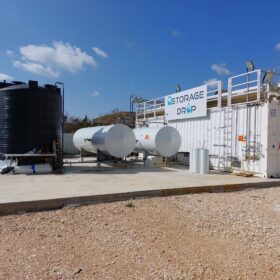
Israeli startup develops PV-driven cooling system based on compressed air
Storage Drop has secured a grant from the European Union to develop its PV-driven cooling system technology for low temperature environments. The system is based on compressed air energy storage technology and a hydraulic isothermal compressor with a water pump that compresses the air in an isothermal process.
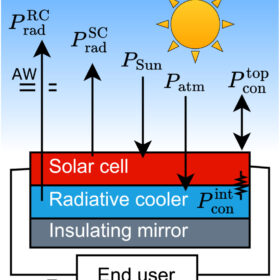
New research shows potential of solar cells based on cement radiative coolers
Researchers in Italy have proposed the use of radiative coolers made of cementitious materials to reduce the operating temperature of solar panels. They incorporated Auger (AUG) and Shockley–Read–Hall (SRH) nonradiative recombination into their modeling and described the practical realization of the coolers as “attractive.”
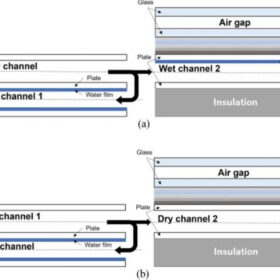
Reducing solar module temperature via dew-point evaporative cooling
Japanese scientists have designed a cooling system that reduces the solar panel operating temperature at the air inlet of the module. It consists of a dew-point evaporative cooler that supplies the near-saturation air to wet air channels that are attached to the back of a PV panel.
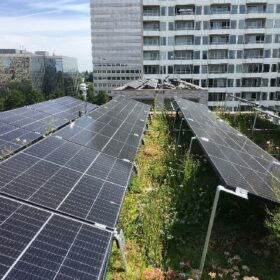
Well-irrigated roofs with vegetation have cooling effect on PV systems
Scientists in the Netherlands have assessed how the so-called blue-green roofs can help reduce the operating temperature of rooftop PV panels and have found they provide a significant cooling effect. The irrigation system used for the research project relies on an additional water supply sourced from grey water from showers that is transformed into irrigation water.
