
Enhancing dual-axis solar tracker performance with new optimization techniques
Researchers in India have developed two solar tracker optimization techniques can purportedly increase power generation by up to 54.36% when combined. One uses a light sensor and the other relies on data from GPS and a real-time clock.
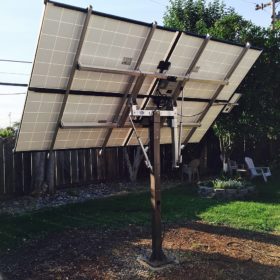
Dual-axis solar tracker based on UV, MEMS sensors
Researchers have designed a new tracking system that utilizes an arithmetic optimization-based PID controller. The proposed tracker uses two different sensor types – a UV sensor and a micro-electromechanical solar (MEMS) sensor. The first one calculates the intensity of UV radiation received from the sun, and the second one forecasts the sun’s path across the sky.

Israeli startup launches agrivoltaic pilot in desert with double-axis sun tracking
Agri-Light has launched its first pilot agrivoltaic project, using a two-axis solar installation on a rail system to move solar panels horizontally above a vineyard in the Negev Desert. The results are due this summer, and the company plans to build commercial projects in Israel and Spain next year.
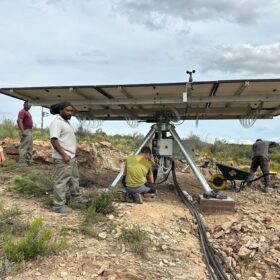
German startup deploys mobile dual-axis solar tracker in South Africa
SunOyster Energy has installed its PVmover system to supply power for a lodge in South Africa’s Sanbona Wildlife Reserve. It includes nine PV modules with a combined capacity of 3.8 kW.
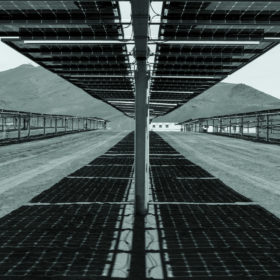
Single-axis bifacial PV offers lowest LCOE in 93.1% of world’s land area
Researchers from the Solar Energy Research Institute of Singapore have concluded that utility-scale PV projects relying on bifacial panels and single-axis trackers deliver the lowest levelized cost of energy in most of the world. They found that the combination of bifacial products with dual-axis trackers is still too expensive, despite the higher yield. The second-lowest LCOE is offered by monofacial single-axis tracker plants.
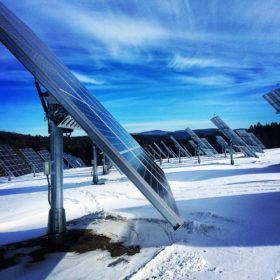
Solar and the snow
Scientists at Sandia National Laboratories in the United States are working to quantify the effects of abundant snowfall on PV systems and to identify cost effective strategies to mitigate energy losses and reliability issues caused by snow and ice.
