Reversible fuel cells for backup power generation
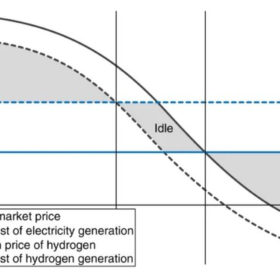
Reversible fuel cell systems based on solid oxide cell (SOC) technology may become an efficient tool to cope with price volatility in the energy market, according to new research from Stanford. Through the proposed model, which mainly considered the electricity markets in Germany and Texas, the research group found that the reversible system may be competitive at current hydrogen prices, provided that there is sufficient variation in daily electricity prices.
Mobile agrivoltaic system from the Netherlands
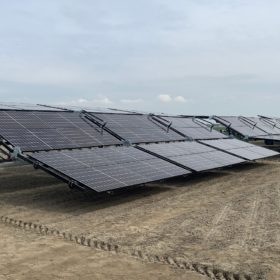
Created by a Dutch group of companies and research institutions, the mobile solar system may also be combined with an electrolyzer for hydrogen generation. Two prototypes are currently being tested by a farmer and a research institute in the Netherlands.
The Hydrogen Stream: Salzgitter claims record efficiency for largest high-temperature electrolyzer
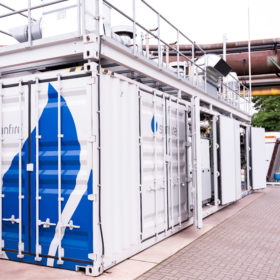
Salzgitter has claimed a record efficiency level for its EU-funded GrInHy2.0 hydrogen project, which is based on solid oxide electrolysis cell tech. The high-temperature electrolyzer uses waste heat from the company’s steel production processes.

The Hydrogen Stream: Fuel cell engines for stationary power uses
In other news, Airbus and Kawasaki Heavy Industries plan to work together to prepare a hydrogen-fueled ecosystem, while Storgrundet Offshore and Lhyfe want to build a 600 MW hydrogen production plant in Sweden. Furthermore, Canada-based First Hydrogen has identified four industrial sites in the United Kingdom and is advancing discussions with landowners to secure land rights to develop green hydrogen production projects.

Power-to-gas-to-power designs to incorporate hydrogen in solar-wind microgrids
Researchers in Mexico have looked at integrating hydrogen-based power-to-gas-to-power into an existing rural microgrid. They said this solution could become competitive if electrolyzer, fuel cell and hydrogen tank costs are halved, or if diesel prices keep rising.
Monolithic fuel cell with power density of 5.6kW/L
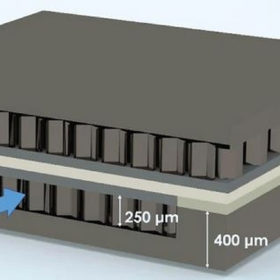
An international research group has developed a solid oxide fuel cell that may be used in vehicles. The monolith device has an active cell area of around 18 cm2 and was built through common manufacturing processes. It was found to achieve a high power density of 5.6 kW/L, which the scientists said is comparable with that of the best performing fuel cells based on ceramic anodes.

Investment cycle means race is on to incentivize green hydrogen
A report published by Irena hints the world’s politicians will have to get to work immediately to avoid another generation of fossil fuel-fired hydrogen, ammonia, and methanol plants being set up to run into the second half of the century.

Australian electrolyzer invention enables green hydrogen under US$1.5/kg by ‘mid 2020s’
“We’re not talking about incremental improvement, this is a really giant leap,” Hysata CEO Paul Barrett told pv magazine Australia. Hysata is commercializing a breakthrough made at the University of Wollongong which effectively, Barrett says, invented a “brand new category of electrolyzer,” vastly improving efficiency.
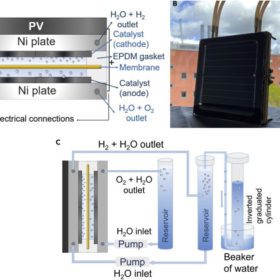
Thermally integrated PV-electrolyzer with 9.1% solar-to-hydrogen efficiency
A Swedish research group has developed a device combining CIGS thin-film solar modules and an alkaline electrolyzer based on a trimetallic cathodic catalyst made of nickel, molybdenum, and vanadium (NiMoV) and an anode made of nickel oxide (NiO). The electrolyzer achieved an average solar-to-hydrogen (STH) efficiency of 8.5% for stable operations during 100 hours.
IHS Markit: Battery prices won’t fall until 2024
The London-based analyst has published a series of clean tech predictions for the year which also highlighted the rising proportion of sub-5MW solar projects in the global market, and cheaper clean energy financing costs even as panel prices continue to rise.
