
Solar glass anti-dumping case sent back to EU’s general court
German company Glasmanufaktur Brandenburg and the European Commission claimed victory in the latest stage of a case which hinges on whether Chinese business Xinyi PV operates as a free-market manufacturer. The suit has been running since May 2014 and no immediate conclusion appears to be in sight.

European Commission approves €2.3bn renewables incentive plan by Greece
Competitive bidding for onshore solar and wind will establish a clean-power strike price acceptable to successful developers under the contracts-for-difference approach. The incentive scheme is also applicable to biogas, biomass, landfill gas, hydropower, concentrated solar power, and geothermal plants.

Ireland cites need for 1.9 GW more solar this decade to stay on track for net zero
Although wind power dominates the renewables scene in the Republic of Ireland and the North – and even natural gas has a bigger role to play – the grid companies of the neighbors have revised up their estimates of how much solar will be needed, after talking to the public and industry.
European Commission refuses to determine lawfulness of French 2006-10 solar FITs
With Paris having retroactively reduced solar feed-in tariff rates guaranteed for 20 years in 2006 and 2010, developer Solar Electric Holding has been unsuccessful in a legal bid to force the commission to decide on the compatibility of the incentive program with EU state aid rules.

SolarPower Europe highlights Polish rooftop incentive as case study for the effectiveness of policy support
The Euro trade body has promised to monitor the developing solar jobs market annually from now on, and pointed to Poland’s position at the top of the tree of EU member states for PV jobs last year as evidence the technology can still benefit from legislative backing.

Lebanon discourages used PV panel imports
Amid reports of panels that should be destined for recycling instead being sold off in the Middle East and Africa, and the potential to bulk out products with non-functioning solar cells, a Beirut-based body has advised the government to shut down second-hand imports.
Faster permitting crucial to help Italy add 70 GW of renewables this decade
In a chat with pv magazine at the Key Energy event in Rimini, Roberta Valenziani, of Italian trade body Elettricità Futura, explained the factors preventing Italy’s PV market from having a renaissance. She said the country has Europe’s longest delays and highest costs for obtaining permits for large scale solar.
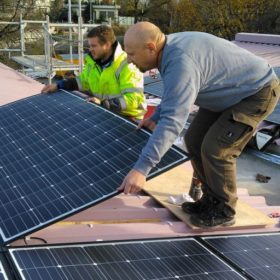
Solar job numbers kept on rising in 2020
The latest edition of a clean power jobs survey produced by IRENA and the International Labour Organization has stressed the important role which will need to be played by the public sector if the energy transition’s employment benefits are to be shared equally.
EU Commission suggests renewable energy PPAs can combat skyrocketing energy prices
The situation in the energy markets is tense. Following national pushes for action, the European Commission has now announced its set of recommendations to combat rocketing energy prices.
European Commission hints at solar module carbon footprint standards
A consultation process examining whether legislation is required to ensure the eco credentials of panels and inverters is focusing on eco-design and energy labeling but has also made mention of the need for less carbon intensive manufacturing.
