Environmental impacts of perovskite PV
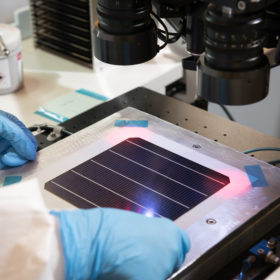
A life-cycle analysis of perovskite-silicon tandem modules indicates that additional environmental impacts in manufacturing are more than offset by the higher energy yield over their lifetime.
Fraunhofer ISE reaches legal settlements with seven inverter manufacturers who infringed its patent
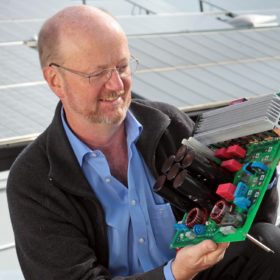
In 2002, the Fraunhofer ISE patented the HERIC circuit for highly efficient inverters. Since then, the institute says, it has recorded out-of-court settlements in seven patent infringement lawsuits against companies from China, Taiwan and Germany.
Powering up PERC-perovskite tandem cells
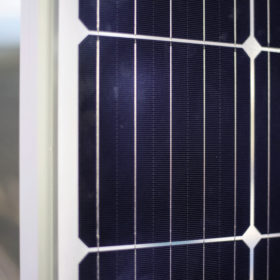
Perovskite-silicon tandem cells offer one of the surest pathways to much higher solar efficiencies, one that has moved close to commercialization in the past few years. Much of the work getting to this stage has naturally focused on developing a viable perovskite top cell. Optimizations to the silicon layer underneath, however, will also be important to the overall device function and efficiency. Scientists in Germany examined five different silicon cell concepts similar to those in mass production today, finding that with a few optimizations these could reach efficiencies up to 30.4%.
Shingled solar modules and shading
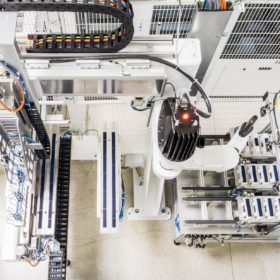
Scientists at Germany’s Fraunhofer Insititute for Solar Energy Systems (ISE) evaluated the performance of its newly introduced ‘Matrix’ approach to interconnecting shingled solar cells. The institute finds that, thanks to optimized current flows, energy yield of the Matrix approach could almost double that of standard shingled cell interconnection under random shading conditions.
Mesoporous carbon for a 20-year stable perovskite solar cell
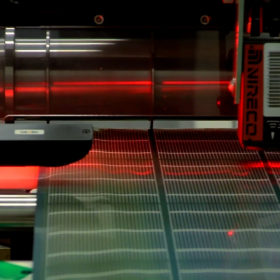
Scientists in Japan and Europe investigated the long-term stability of perovskite solar cells utilizing layers of mesoporous carbon, building on previous work demonstrating the strong potential of this approach. This latest work demonstrates a light-soaking effect, which allowed them to fabricate cells that retained 92% of their initial performance after 3,000 hours in damp heat conditions – which the researchers say is equivalent to 20 years in the field.
Scaling up perovskite-silicon tandem solar cell performance
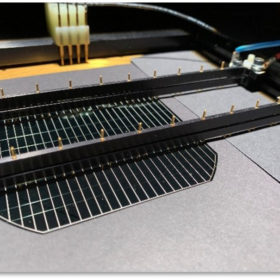
Scientists in Germany investigated various routes to optimizing cell design for perovskite-silicon tandem products. Beyond the perovskite layer itself, they note several other areas that should be optimized for tandem cells, taking silicon heterojunction processing as a starting point. The research identifies several routes to cut costs in cell production, including a significant reduction in indium consumption.
New ‘matrix’ layout for shingled solar cells
German equipment supplier M10 and research institute Fraunhofer ISE will unveil a new prototype stringer for shingled module layouts at the Intersolar Europe trade show later this week. Employing an offset layout for the shingles, the approach promises a relative efficiency gain of up to 6%, compared to a conventional half-cell module.
Europe had just 650 MW of solar cell manufacturing capacity at the end of 2020
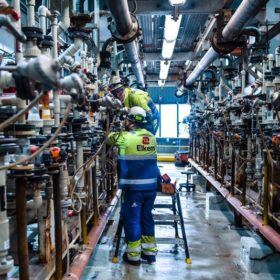
The latest update to the Photovoltaics Report produced by research organization the Fraunhofer ISE has offered up the usual slew of interesting stats on the state of solar across the continent.
Maxeon secures EU cash to make its ‘stick-on’ solar panels in France
The TotalEnergies-controlled solar manufacturer will secure an, as yet undetermined chunk of a new €118.6 million low-carbon innovation fund to start producing its frameless, glass-free solar roofing products at Porcelette, in northeastern France.
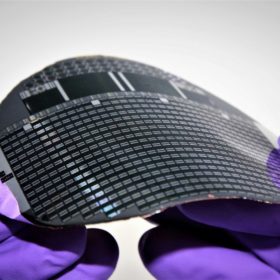
Fraunhofer ISE unveils 68.9%-efficient III-V solar cell for laser energy transmission systems
The German research institute said the gallium arsenide cell has achieved the highest efficiency to date for the conversion of light into electricity.
