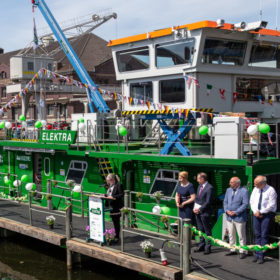
The Hydrogen Stream: World’s first hydrogen-powered towboat
Shipbuilder Hermann Barthel has developed the world’s first push boat to combine battery-electric propulsion with hydrogen and fuel cell technology. Iberdrola and Fertiberia, meanwhile, have commissioned Europe’s largest green hydrogen production plant.
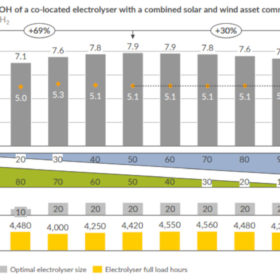
Green hydrogen price may drop to €5 kg by 2025
Aurora Energy Research says in a new report that maximum green hydrogen project profitability could be achieved when solar and wind power plants are combined with electrolyzers.

Investors present European legislators with hydrogen economy wishlist
If the EU is going to drive more than half a trillion dollars worth of hydrogen investment over the coming decades, it will need to get investors onside. The European Investment Bank has surveyed financiers to find out what they want.
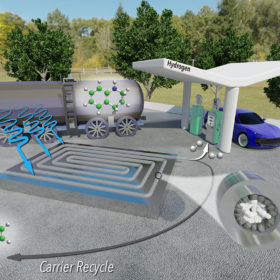
The Hydrogen Stream: Novel tech for extracting hydrogen gas from liquid carriers
North Carolina State University (NCSU) has developed an energy-efficient strategy for room-temperature hydrogen release from liquid hydrogen carriers, which uses less rhodium. Elsewhere in the world, Airbus launched its Zero Emission Development Centre in the UK, Toshiba ESS teamed up with Fusion Fuel to target Australian and European markets, and Corfo signed agreements to finance three renewable hydrogen projects with GNL Quintero, iCAP, and Air Liquide in Chile.
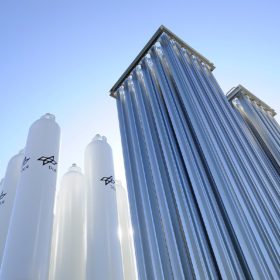
Australian developer pushes ahead with green hydrogen production plans
Frontier Energy has identified its preferred electrolysis technology as it advances plans to produce green hydrogen powered by the proposed 500 MW Bristol Springs Solar project in Western Australia.
About 400 GW of solar, wind needed per year to keep mercury rise below 1.5 C
Academics in Denmark and Berlin have calculated Europe will need 400 GW of new solar and wind facilities per year from 2025 to 2035 to contribute to capping global temperature rises, in line with the Paris Agreement.
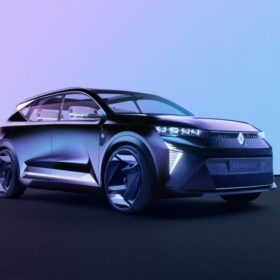
The Hydrogen Stream: Renault presents electric-hydrogen hybrid car with range of up to 800 km
In other news, Shinshu University researchers developed a graphene-wrapped molecular-sieving membrane that is reportedly 100 times more efficient than that of conventional polymer separation membranes. Topsoe aalso nnounced the construction of the “world’s largest electrolyzer production facility,” and Toho Gas said it would produce blue hydrogen in Japan for local consumption.
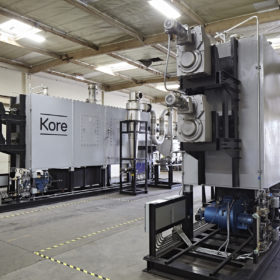
New method could potentially produce hydrogen from biogas for $2/kg
Kore, an energy startup in California, has developed a new way to produce hydrogen from biogas, and is now poised to build a commercial-scale demonstration facility in Los Angeles. It said half of the carbon in the feedstock can be converted into gas, while the other half can be converted into solid elemental carbon char.
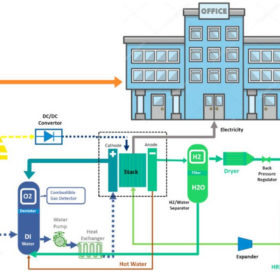
Cost comparison between lithium batteries, fuel cells, reversible solid oxide cells as storage for off-grid rooftop PV
Scientists in the United Arab Emirates have looked at how off-grid rooftop PV could be combined with batteries, fuel cells or reversible solid oxide cells for energy storage. The modeling assumed a typical commercial building in Los Angeles.
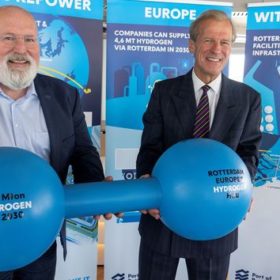
The Hydrogen Stream: Carbon-coated nickel anode to solve problems of hydrogen fuel cell without precious metals
A team of researchers from the University of Wisconsin-Madison, Cornell University, and Wuhan University have presented a completely precious metal–free alkaline fuel cell with enhanced performance using a carbon-coated nickel anode. Meanwhile, the Port of Rotterdam has offered to supply northwestern Europe with 4.6 million tonnes of hydrogen by 2030. According to RMI, Europe will import green hydrogen between 2024 and 2030. RenewableUK sees room for hydrogen exports from the UK to the EU.
