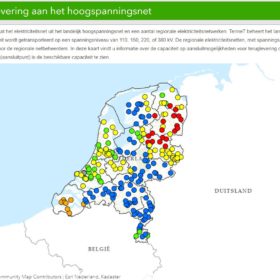
Dutch transmission system operator releases online map showing available grid capacity
The interactive map gives solar and wind project developers, as well as regional grid operators direct insight into where and how much capacity is available at Tennet’s high-voltage stations.
Dutch grid company notifies further lengthy bottlenecks
The final 980 MW of transmission capacity in parts of the Friesland regional grid have been allocated to generation projects, and state-owned network business Tennet says bottlenecks could occur over the next seven years.
Tennet begins internet-of-things grid balancing project
Household heat pumps, EV chargers and rooftop solar panels will be able to earn their owners benefits in return for helping to balance grid networks struggling to accommodate new solar and wind power generation.
Dutch farmers left with no connection for their PV arrays
Grid congestion issues are increasing in the Netherlands and several Dutch farmers claim to have remained without access to the grid despite having completed their rooftop arrays.
Model agreement to make solar and wind share same connection point in the Netherlands
The model agreement was outlined by Dutch consultancy Ventolines B.V. and follows the introduction of new provisions for the sharing of the same connection point issued by the country’s government last year.
Dutch grid operator mulls incentives to reduce or curtail solar
The Limburg section of the network could face congestion problems for a decade, according to transmission system operator Tennet, prompting talk of offering auction-determined incentives to clean-power generators to reduce their output.
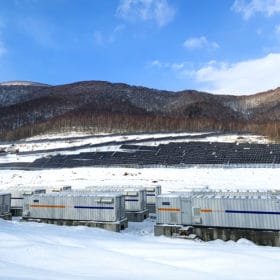
Solar-plus-storage as an antidote to grid congestion in Japan’s northern island of Hokkaido
Chinese inverter maker Sungrow has switched on a 6 MW / 21 MWh solar-plus-storage facility on the island. The FIT project’s connected AC capacity is limited to only 845 kW, but the containerized storage solution provided by the company ensures its viability.
Netherlands’ largest power provider wants to connect new solar parks to 75% of their peak capacity
Liander said its new plan may result in savings ranging from €1.4 billion to €1.8 billion. Possible losses for PV power producers are estimated at a maximum of 3% of their electricity production per year. If implemented, this new measure would push PV project developers to rely on underdimensioned inverters.
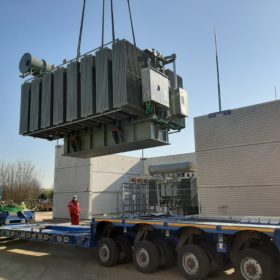
Giant transformers for grid debottlenecking
Dutch power company Liander has installed two large transformers at a distribution station in Ulft, in the province of Gelderland. The devices should provide more room for renewables on the network from next year.
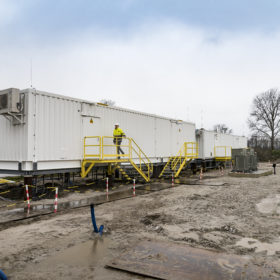
Netherlands to address renewables grid constraints with 1 GW of mobile substations
Dutch transmission system operator Enexis is deploying 11 “e-house” substations in the northern Netherlands, where grid capacity for large scale clean energy projects is limited. The company said it will invest €43 million in the plan “to speed up the energy transition”.
