
Capacity utilization a key issue in a world energized by renewables and hydrogen
A European research team has investigated the implications of renewable energy intermittency on capital utilization across a future electricity-hydrogen system, including transmission and storage infrastructure. According to its findings, idle capacity substantially increases the system costs and limits wind and solar development.

The geopolitical impact of hydrogen
In an interview with pv magazine, Indra Overland, head of the Center for Energy Research at the Norwegian Institute for International Affairs, explains how international hydrogen strategies may play out in the upcoming decades. Plans and roadmaps will not be enough to turn a hydrogen economy into reality and its success will depend on becoming cost-competitive vis-à-vis other solutions in several areas, he says.
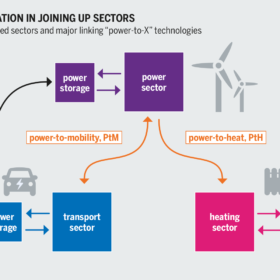
Power-to-X may cover 28% of global energy demand by 2050
The so-called powerfuels are primarily required for sectors that are difficult to electrify, such as aviation and shipping, as well as for the processing of raw materials. This is shown by a new study by Finland’s LUT University and the German Energy Agency.

Scotland stimulates hydrogen economy with £100m investment
Scotland aims to install 25 GW of electrolyzer capacity by 2050.

Canada joins hydrogen race with dedicated strategy
The new hydrogen plans of the Canadian government will be supported by a US$1.7 billion fund for low-carbon and zero-emission fuels.
Italy’s Snam says 70% of pipeline system now hydrogen-ready
Italian gas infrastructure specialist Snam has announced plans to develop global hydrogen-related mobility solutions and applications. It tells pv magazine that it wants to build an “energy bridge” between Europe and North Africa.

Green hydrogen costs could plunge in India by 2030
A cost decline of more than 50% by the end of the decade could make green hydrogen cost-competitive with hydrogen from fossil fuels in certain industrial applications, such as ammonia production for fertilizers.
Improving PV-based hydrogen generation with loss‐mitigation techniques
Australian scientists have demonstrated two loss-mitigation techniques that could improve solar‐to‐hydrogen (STH) conversion efficiencies and may lay the ground for cheaper PV-powered hydrogen generation. By combining the two techniques, they were able to achieve an STH efficiency of around 19.4% at realistic operating temperatures.

Engie, Australian ammonia supplier to build hydrogen hub
Engie has published the findings of its long-awaited feasibility study with Yara on the development of renewable hydrogen and ammonia. They plan to build new large-scale facilities in Western Australia, starting with a 10 MW solar farm and electrolyzer.

Enel, Eni to build joint 20 MW pilot green hydrogen project
The two Italian energy giants have joined forces to bring online 20 MW of hydrogen capacity between 2022 and 2023. Two 10 MW pilot electrolyzers will be built at unspecified Eni refineries.
