Australian startup, EDF team up to test electrolzyer tech
A startup spun out of the Australian Commonwealth Scientific and Industrial Research Organisation (CSIRO) has secured a grant to build a 5 kW electrolyzer that will be deployed at a UK power plant operated by French energy utility EDF.
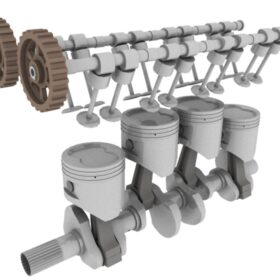
Improving LCOE of PV-driven hydrogen via reciprocating engines
UNSW scientists have suggested to use dual-fuel reciprocating engines for adding gas-to-power operations in large scale production of hydrogen based on PV power. The preliminary findings of their research show that the proposed system is still achieving a too high LCOE for commercial maturity. Decreasing electrolyzer costs, policy interventions and changing energy market dynamics, however, may more than halve the LCOE values in the future.

Techno-economic feasibility of hydrogen storage in hydro-dominated countries
Scientists have investigated different techno-economic scenarios for using hydrogen storage in combination with hydropower and pumped hydro storage in Switzerland. They have found that hydrogen storage plays no major role under most conditions.

Off-grid solar-wind power plant design for green hydrogen generation
Scientists in Czechia have conducted a techno-economic analysis of a green hydrogen production system powered exclusively by photovoltaic and wind energy. The system uses surplus energy for water treatment and, according to its creator, can achieve a levelized cost of hydrogen of $3.12/kg.

Solar-hydrogen solution rolled out for off-grid settings
A new mobile power generator that combines solar and renewable hydrogen to provide zero-emissions power for remote and off-grid applications has been unveiled by Australian startup H2PowerBox.

Low platinum fuel cells for hydrogen vehicles
New research from Sweden suggests that low platinum fuel cells for hydrogen vehicles, when scaled up for the same number of cells, may achieve similar or higher efficiencies compared to commercial fuel cells. Their modeling is expected to act as a bridge between material science research and vehicle implementation.
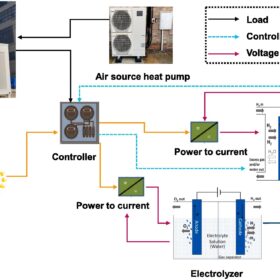
PV-driven hybrid hydrogen fuel cell system for building applications
Scientist in Canada have proposed to combine rooftop PV power generation with an alkaline electrolyzer and a fuel cell to generate hydrogen in buildings. The new system is intended at enabling seasonal energy storage and reduce a home’s levelized cost of energy.
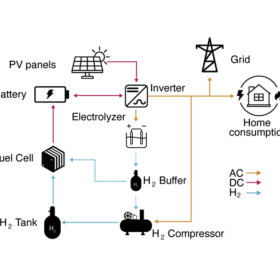
New model shows how to power homes exclusively with hydrogen, solar, batteries
Researchers in Spain has found that combining PV power generation with fuel cells and battery storage may help homes considerably reduce their levelized cost of energy. Their simulation reportedly demonstrated homes may also become completely self-sufficient.

EU to provide €720 million to support hydrogen projects
The European Hydrogen Bank’s pilot auction is delivering €720 million ($768.3 million) to seven renewable hydrogen projects in Finland, Norway, Portugal and Spain. Together, they plan to produce 1.58 million tons of renewable hydrogen over a period of 10 years.
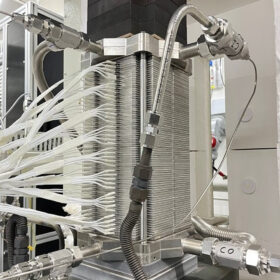
Korean researchers build 8 kW solid oxide electrolysis cell that can produce 5.7 kg of hydrogen per day
The Korea Institute of Energy Research has developed a solid oxide electrolysis cell stack that uses a special kind of separator plate to ensure proper flow of hydrogen and oxigen after water splitting. Samsung Electro-Mechanics and Bumhan Industries are now cooperating with the research center to improve relevant manufacturing process.
