Israel shortlists 11 bidders in 300 MW solar-plus-storage tender
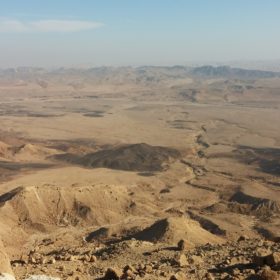
Construction of the solar-plus-storage facility is scheduled to take place in the Negev desert in late 2021, with completion expected in 2023.
Greece, Cyprus and Israel take a further step to link their grids
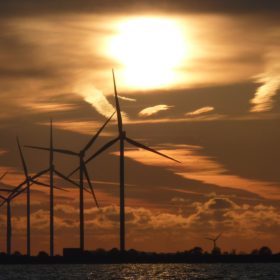
The three Mediterranean countries of Greece, Cyprus and Israel signed this week an agreement to develop a subsea cable that links their electricity grids. Upon completion, the so-called EuroAsia Interconnector will be the world’s longest subsea power cable and could boost solar PV development in all three countries substantially.
Israel reveals bidders for 300 MW solar-plus-storage tender in Negev Desert
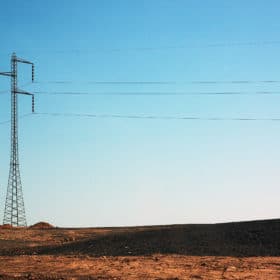
The Israeli authorities have selected 24 bidders for the tender’s final phase. Construction of the solar-plus-storage facility is planned for late 2021, and completion in 2023.
Israeli government wants to boost development of agrivoltaics
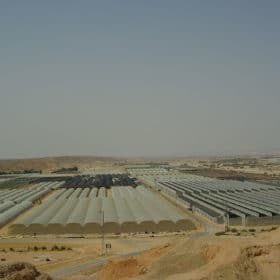
The Israel Ministry of Energy and the Ministry of Agriculture have decided to implement a pilot research program to assess the feasibility of agrivoltaic projects in the country. The possibility of combining PV and agriculture in a land with limited land availability and increasing energy demand is considered a win-win solution by the government.
Israel’s second tender for solar-plus-storage concludes with final price of $0.0544/KWh
The Israeli government assigned 608.9 MW of PV capacity through the tender and selected seven developers for 33 projects. A storage capacity of around 2,400 MWh will be linked to the selected solar power projects.
Israeli government greenlights plan to add 15 GW of solar by 2030
The plan envisages to reach a 30% share of renewable energies in the country’s electricity mix by 2030. An intermediate target of 20% has been set for 2025.
Israel’s solar-plus-storage tender concludes with final price of $0.0578/kWh
The government assigned 168 MW of capacity through the tender and selected three developers for 11 projects, with capacities of 100 MW, 48 MW and 20 MW.
Israel wants another 15 GW of solar by 2030
Energy minister Yuval Steinitz has announced the country’s 2030 renewable energy target will rise to 30%, with solar expected to account for the lion’s share. Approximately $23 billion more clean energy investment is envisaged this decade.

Israeli national lottery supports rooftop PV program with $0.12/kWh feed-in tariff
The incentive scheme awards a 23-year, $0.12/kWh feed-in tariff to rooftop arrays with a generation capacity of up to 200 kW. Already, 141 municipalities have applied to install 116 MW of rooftop solar capacity and the government has increased the program’s budget from $28.5 million to $143 million.
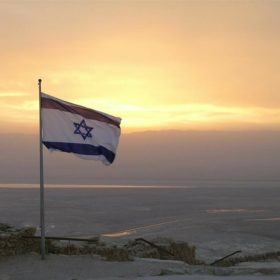
Israel’s plan to recover from Covid-19 crisis includes 2 GW of new solar
The country also intends to continue the procurement exercise for the Dimona solar power plant in the Negev desert. The Israeli government also will try to remove barriers to facilitate rapid and efficient development, while improving the grid-connection process for projects.
