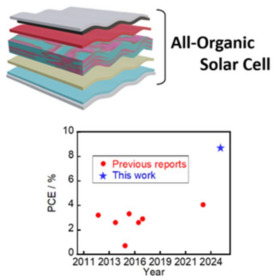
Scientists fabricate all-organic solar cell with record 8.7% efficiency
A team of Japan-based scientists have set a new power conversion efficiency record for all-organic solar cells, more than doubling the previous record. They say the cell was developed with rganic electrodes with high conductivity that required no acid doping or high-temperature heating, which avoids damage to the plastic substrates.
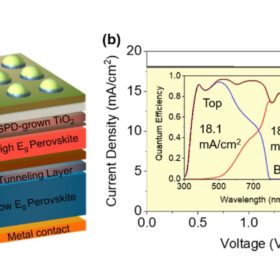
Multi-layer front contact perovskite solar cells with 16.55% efficiency
Japanese scientists have used spray pyrolysis deposition to fabricate perovskite solar cells based on a titanium oxide electron transport layer. They claim that the cells have the potential to reach a power conversion efficiency rating of more than 30%.
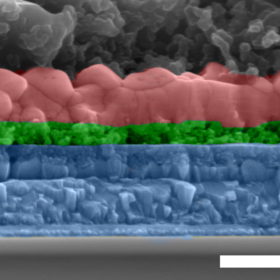
Japanese scientists trial printing on perovskite
Researchers from three Japanese universities have developed a process based on inkjet printing they say could reduce the cost of perovskite solar cell production. The group fabricated small cells with efficiencies as high as 13.19%, a figure they claim is promising enough to offer the possibility of scaling up to commercial production.
