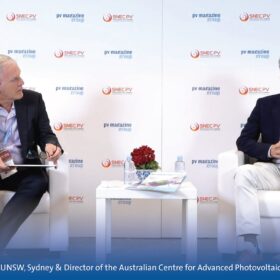
Imminent introduction of perovskite-silicon tandems is unlikely, says Prof. Martin Green
At SNEC 2024 in Shanghai, pv magazine spoke with Martin Green, Scientia Professor at the University of New South Wales and solar cell technology expert. He said perovskite-silicon tandem technologies still have a long way to go before reaching commercial maturity and predicts silicon-based technologies will still dominate the market for many years. He also sees potential for copper zinc tin sulfide (CZTS) solar cells and other absorber materials. “Until we don’t solve the stability issues with perovskite, is good to have other candidates,” he stated.
Reverse bias – a hidden challenge for perovskite solar cell stability
New research from renowned PV scientist Martin Green and colleagues at UNSW reveals that perovskite solar cells may struggle to deal with reverse-bias caused by uneven shading or other issues likely to appear in the field. Both the reverse-bias itself and resulting build up of heat can cause several of the materials commonly used in perovskite solar cells to degrade, and these issues have received only limited attention in research published to date. Solutions, however, are at hand.
Rystad doubles IEA calculations on solar PV required by 2050
Solar rules in any scenario of what the world needs to work toward over the next three decades to keep global warming under 1.5 C.
The Weekend Read: Technology is accelerating
Research and development: Martin Green has attended the SNEC every year since its inception. During that time, he and his University New South Wales (UNSW) collaborators have driven a wide range of innovations within the Chinese and global PV manufacturing sector. Green, a Scientia Professor at UNSW and the Director of the Australian Centre for Advanced Photovoltaics shares his take on PV technology in 2018.
Getting ready for terawatts of solar (with charts)
Researchers from NREL, Fraunhofer ISE and Japan’s AIST have released a new paper which looks at the barriers to deploying multiple terawatts of solar PV and what can be done to overcome them.
