
Oxford PV targets 20-year lifetime for perovskite-silicon tandem modules by 2028
Oxford PV CEO David Ward spoke with pv magazine about the prospects of its company and the perovksite-silicon tandem PV technology at the WFES event in Abu Dhabi. He said Oxford PV is expanding manufacturing beyond Germany while focusing on global licensing partnerships.

Singapore team develops durable perovskite-silicon tandem solar cells
National University of Singapore scientists claim that vapor-deposited perovskite-silicon tandem solar cells built on industrial silicon wafers achieve both high efficiency and long-term thermal stability, addressing a central barrier to commercial deployment.

JinkoSolar achieves 34.76% efficiency for perovskite-silicon tandem solar cell
JinkoSolar says it has increased the efficiency rating for its perovskite-silicon tandem solar cells from 34.22% to 34.76%, confirmed by China’s National PV Metric & Testing Center (NPVM).

Fraunhofer ISE streamlines use of epitaxial wafers in TOPCon solar cell manufacturing
Researchers at the German research institute have demonstrated that the so-called EpiWafers could be used directly for solar cell fabrication without needing a pre-gettering step. Their experiments provide a proof of principle* for epitaxially grown silicon wafers from German wafer manufacturer NexWafe GmbH.

Scientists testing perovskite-silicon tandem solar cells with interdigitated back contacts
A research team in Iran has designed a four-terminal perovskite-silicon tandem solar cells with a 19.3%-efficient bottom heterojunction cell and a 12.7%-efficient perovskite top cell. Both subcells were conceived to have interdigitated back contacts, with the top cell reportedly helping to improve the tandem device’s light-trapping and efficiency.
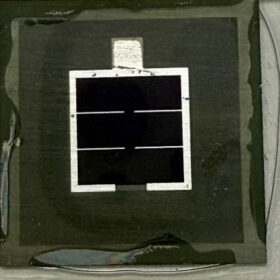
Taiwanese researchers unveil 31.5%-efficient perovskite-silicon tandem solar cell
The cell utilizes a heterojunction device as the bottom cell and a perovskite top cell integrating a hole transport layer made of nickel(II) oxide and methyl-substituted carbazole.
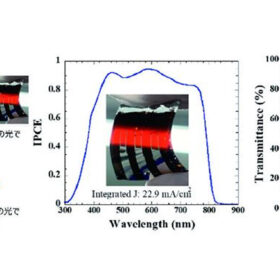
Enecoat claims 30.4% efficiency for four-terminal perovskite-silicon tandem solar cell
The Japanese manufacturer said its tandem cell utilizes a top perovskite solar cell with an efficiency of 22.4% and 81% infrared transmittance.

Perovskite-silicon tandem solar cell based on indium oxide buffer layer achieves 30.04% efficiency
Researchers in China have fabricated a perovskite-silicon tandem solar cell that utilizes an indium oxide sputtering buffer layer to protect the perovskite absorber and the electron transport layer from potential damages arising from the electrode deposition process. The new layer not only ensured this protection but also showed strong optical and electrical properties.
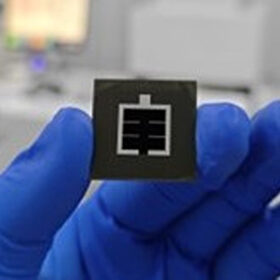
Perovskite-silicon tandem solar cell based on copper(I) thiocyanate achieves 31.46% efficiency
A Saudi-Chinese research team has fabricated a perovskite-silicon tandem solar cell without a hole transport layer (HTL) in the perovskite top cell. This innovative strategy, based on the co-deposition of copper(I) thiocyanate and perovskite in the top cell absorber, was intended at solving typical issues of HTLs in tandem devices.
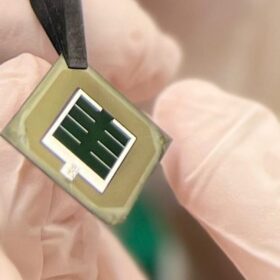
KAUST, Helmholtz-Zentrum Berlin present 31.2%-efficient blade-coated perovskite-silicon tandem solar cell
The perovskite-silicon tandem device has a two terminal configuration and a 2D perovskite layers at the bottom interface. It was able to retain around 80% of its initial efficiency for 1,700 h.
