Indian researchers present 28%-efficient silicon-perovskite tandem solar cell
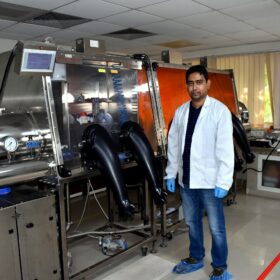
A research group at the Indian Institute of Technology Roorkee has fabricated 4-terminal silicon-perovskite tandem solar cells with power conversion efficiency of 28%. The team is now scaling up this technology to match 18.2 cm x 18.2 cm, commercial M10 solar cells dimension.
KAUST builds perovskite-perovskite-silicon tandem solar cell with 31.5% efficiency
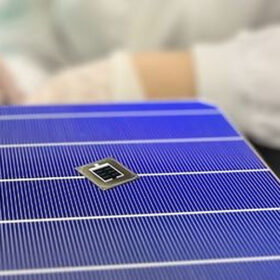
The Saudi research institute said its new four-terminal tandem device has achieved the highest efficiency ever reported for perovskite-based 4-T and triple-junction tandem solar cells to date. The key feature of the cell is the hole transport layer of the top perovskite cell, which was engineered with self-assembled monolayers.

Longi claims 34.6% efficiency for perovskite-silicon tandem solar cell
The European Solar Test Installation (ESTI) has confirmed Longi’s achievement of a world record-breaking efficiency rating of 34.6% for a perovskite-silicon tandem solar cell.
CEA-INES, Enel achieve 28.4% efficiency for tandem perovskite-silicon solar cell
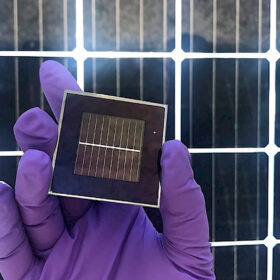
CEA-INES researchers and Enel have developed a new solar cell with an active area of 9 cm² and an open-circuit voltage above 1,900 mV. Their results improve on the 27.1% efficiency they achieved for the same kind of cell in June.
Perovskite-silicon tandem solar cells have practical efficiency potential of 39.5%
Researchers at Germany’s Fraunhofer ISE have provided guidelines for future research on perovskite-silicon tandem solar cells by identifying the most significant loss mechanisms at the perovskite/ETL interface, in the series resistance, and in light management.

Voltec Solar secures funds to make perovskite-silicon tandem modules
Voltec and the Institut Photovoltaïque d’Île-de-France (IPVF) plan to set up a pilot line for their new tandem panel tech in 2023 and their first 200 MW industrial demonstrator in 2025. They also plan to increase the factory’s capacity to 1 GW in 2027 and 5 GW by 2030.

Perovskite-silicon tandem cell achieves 28.9% efficiency via high bandgap top perovskite cell
A group of international researchers has developed a new perovskite-silicon solar cell design using a top perovskite PV device with an energy bandgap of 1.67 eV and a new self-assembly monolayer based on carbazole. The tandem cell achieved a higher efficiency compared to counterparts without the monolayer and passed the IEC 61215 standard thermal cycling test.
Longi claims 33.9% efficiency for perovskite-silicon tandem solar cell
The US Department of Energy’s National Renewable Energy Laboratory (NREL) has confirmed Longi’s achievement of a world record-breaking efficiency rating of 33.9% for a perovskite-silicon tandem solar cell.
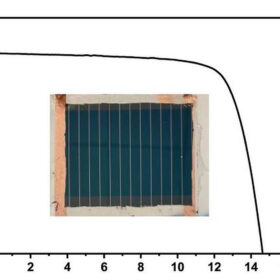
Large-area perovskite-silicon tandem PV cell hits record efficiency of 25.1%
US scientists have achieved a breakthrough in PV cell tech by creating a 24 cm2 perovskite-silicon tandem solar cell. It positions a lithium fluoride interlayer between a hole transport layer and the perovskite absorber to reduce shunting losses.
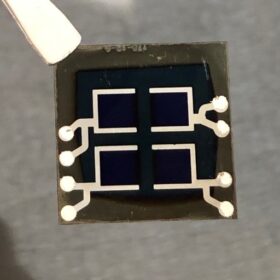
Two-terminal perovskite silicon tandem solar cell with 25.6% efficiency
The Fraunhofer ISE has developed an electro-optically optimized transparent conductive oxide layer that can reportedly improve the efficiency of perovskite-silicon tandem solar cells. A device built with the film achieved remarkable efficiency and fill factor.
