
Longi claims 34.6% efficiency for perovskite-silicon tandem solar cell
The European Solar Test Installation (ESTI) has confirmed Longi’s achievement of a world record-breaking efficiency rating of 34.6% for a perovskite-silicon tandem solar cell.
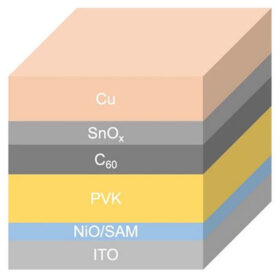
Perovskite-silicon tandem solar cell treated with n-Butanol achieves 29.4% efficiency
Researchers in China have built a tandem-perovskite solar cell with a top perovskite device based on an absorber treated with n-butanol, which reportedly reduces the detrimental effects of moisture in manufacturing processes carried out in air environment. The result is a tandem cell with improved charge collection.
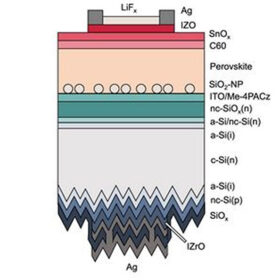
EPFL unveils perovskite-silicon tandem solar cell with certified efficiency of 30.9%
The tandem solar cell is based on a perovskite top cell treated with an additive known as 2,3,4,5,6-pentafluorobenzylphosphonic acid (pFBPA), which reportedly improves its power conversion efficiency and fill factor. The tandem device also integrates a bottom heterojunction silicon cell made with a 190-μm-thick, 2 Ω.cm, n-type, float-zone, shiny-etched monocrystalline wafer.
Perovskite-silicon tandem solar cells have practical efficiency potential of 39.5%
Researchers at Germany’s Fraunhofer ISE have provided guidelines for future research on perovskite-silicon tandem solar cells by identifying the most significant loss mechanisms at the perovskite/ETL interface, in the series resistance, and in light management.

Perovskite-silicon tandem cell achieves 28.9% efficiency via high bandgap top perovskite cell
A group of international researchers has developed a new perovskite-silicon solar cell design using a top perovskite PV device with an energy bandgap of 1.67 eV and a new self-assembly monolayer based on carbazole. The tandem cell achieved a higher efficiency compared to counterparts without the monolayer and passed the IEC 61215 standard thermal cycling test.
Longi claims 33.9% efficiency for perovskite-silicon tandem solar cell
The US Department of Energy’s National Renewable Energy Laboratory (NREL) has confirmed Longi’s achievement of a world record-breaking efficiency rating of 33.9% for a perovskite-silicon tandem solar cell.
Sharp claims 33.66% efficiency for silicon tandem solar cell
The Japanese electronic manufacturer said this is the world’s highest efficiency for a stacked solar cell that combines a tandem double-junction solar cell and a silicon solar cell.
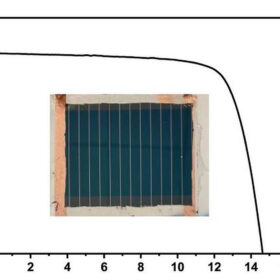
Large-area perovskite-silicon tandem PV cell hits record efficiency of 25.1%
US scientists have achieved a breakthrough in PV cell tech by creating a 24 cm2 perovskite-silicon tandem solar cell. It positions a lithium fluoride interlayer between a hole transport layer and the perovskite absorber to reduce shunting losses.
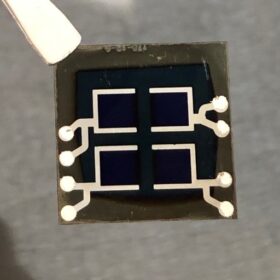
Two-terminal perovskite silicon tandem solar cell with 25.6% efficiency
The Fraunhofer ISE has developed an electro-optically optimized transparent conductive oxide layer that can reportedly improve the efficiency of perovskite-silicon tandem solar cells. A device built with the film achieved remarkable efficiency and fill factor.
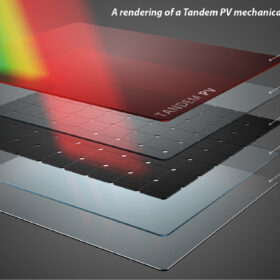
Weekend Read: Pushing perovskite PV limits
The perovskite solar race is heating up, with a cue of manufacturers forming to test products at the US Department of Energy’s (DoE) PV commercialization facilities, and academics on both sides of The Pond announcing new advances in recent months.
