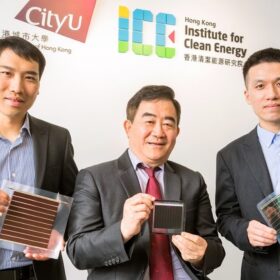
Monolithic perovskite-organic tandem solar cell achieves 24.27% efficiency
Researchers at City University of Hong Kong have developed a monolithic perovskite-organic tandem solar cell with a wide-bandgap subcell that reportedly provides “remarkable” stability. The tandem device achieved one of the highest efficiencies ever reported for this type of solar cell technology.
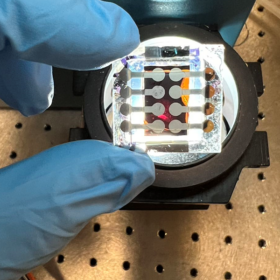
All-perovskite tandem solar cell based on tin-lead perovskite achieves 28.8% efficiency
An international research team has developed an all-perovskite tandem PV device that reportedly shows reduced recombination losses in the cell’s bottom device and remarkable stability. To improve the perovskite solar cell’s surface, the scientists created partially non-conductive and non-functional areas that protect the perovskite area underneath from becoming defective.
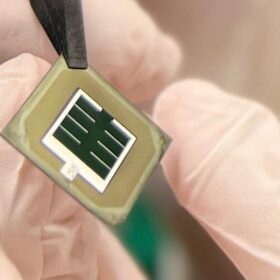
KAUST reveals details of 33.7%-efficient perovskite-silicon tandem solar cell
In a new scientific paper, researchers from the King Abdullah University of Science and Technology (KAUST) in Saudi Arabia presented the 33.7%-efficient perovskite-silicon tandem solar cell announced in May last year. They explained the device is based on a perovskite additive known as tetrahydrotriazinium that reportedly enhances the phase stability of the perovskite film under heat and light conditions.
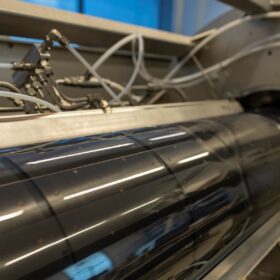
Kalpana Systems launches roll-to-roll spatial atomic layer deposition tools
Kalpana Systems, a Dutch equipment manufacturer, is launching spatial atomic layer deposition (sALD) tools to be used in roll-to-roll manufacturing processes in the solar PV, organic light emitting diode, battery and packaging industries. The initial application is expected to be barrier layer deposition.
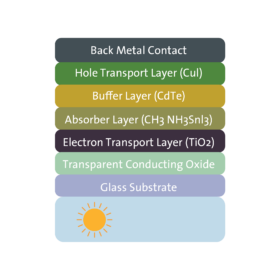
Improving perovskite solar cell performance with cadmium telluride buffer layer
An international research team has conducted a series of simulations to investigate how a cadmium telluride buffer layer may help increase efficiency and stability in perovskite solar cells. Their experiment showed that cell efficiency may climb from 11.09% to 23.56%.
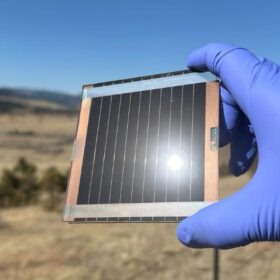
U.S. startup develops 28%-efficient perovskite-silicon tandem solar module
U.S.-based PeroNova is specialized in metal halide perovskite-silicon tandem solar cells made with its novel stability-enhancing interfacial treatment. It is targeting a range of applications including space and rooftop markets.
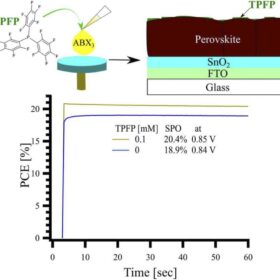
Thin-film perovksite solar cell based on fluorinated phosphoric acid achieves 20.5% efficiency
Japanese scientists built a thin-film perovskite solar cell incorporating fluorinated phosphoric acid (TPFP) into the absorber’s precursor solution. The device achieved remarkable power conversion efficiency due to effective passivation at the interface between the perovskite film and the hole transport layer.

Self-cleaning perovskite solar cell based on leek leaves-like film achieves 14.2% efficiency
Scientists in Finland have built a perovskite solar cell with a bio-inspired coating that reportedly improves light transmittance while providing self-cleaning properties. The film was able to improve the device efficiency by up to 6%.
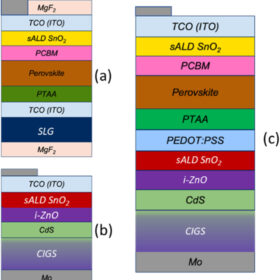
Two-terminal perovskite-CIGS tandem solar cells have technical potential to achieve 26.69% efficiency
A Dutch and U.S. research team performed optical and electrical simulations to understand loss mechanisms in two terminal (2T) tandem cells based on perovskite and commercially available copper-indium-gallium-selenide (CIGS) cells, and subsequently established a roadmap to increase efficiency via four key modifications.
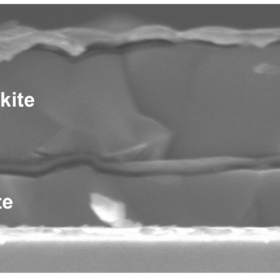
All-perovskite tandem solar cell based on tin-lead perovskite achieves 27.8% efficiency
Scientists in the United States have fabricated an all-perovskite tandem solar cell that reportedly shows reduced interfacial energy loss in the cell’s top device. It was built with a hole transport layer based on a compound known as P3CT that was doped with lead iodide.
