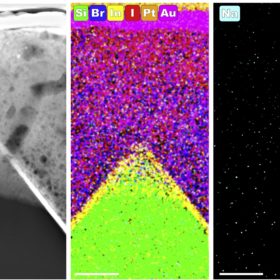
Solar perovskite tandems and potential-induced degradation
Scientists have found that perovskite solar cells and perovskite-silicon tandems might be vulnerable to potential-induced degradation. They exposed tandem cell devices to PID stress and found that they lost as much as 50% of their initial performance after just one day.

The economics of perovskite solar manufacturing
Scientists in Switzerland put together a detailed analysis of the projected costs of designing and operating a 100 MW perovskite solar cell production line in various locations, taking in labor and energy costs as well as all materials and processing. The found that perovskite PV could be cost-competitive with other technologies even at much smaller scale, but noted that this still depends on the tech proving its long-term stability, and impressive achievements in research being successfully transferred to commercial production.

New ferroelectric material for lead-free perovskite solar cells
US scientists have discovered a lead-free perovskite material with ferroelectric properties that can be used in solar cells. The perovskite compound was grown from cesium germanium tribromide and initial analysis shows that it produces ferroelectricity.
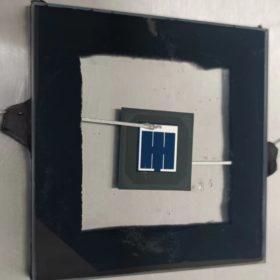
Perovskite-silicon tandem single-cell solar module with 26.2% efficiency
Researchers in Saudi Arabia claim to have reduced cell-to-module losses in tandem perovskite silicon photovoltaic devices through an optical redesign of the module through refractive-index engineering. They built a monolithic perovskite-silicon tandem mini-module with a power conversion efficiency of 26.2%.
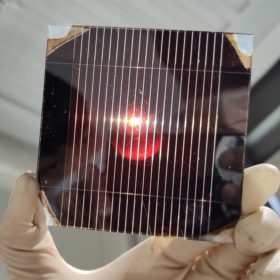
Controlling the crystals for a 17.96% efficient perovskite solar cell
Scientists in Taiwan demonstrated a new way to produce high-purity lead-iodide, as a precursor material for a perovskite solar cell. By using temperature to better control the orientation of crystals, the group was able to show much higher efficiencies when the precursor was used to fabricate a perovskite layer and subsequently a working solar cell.
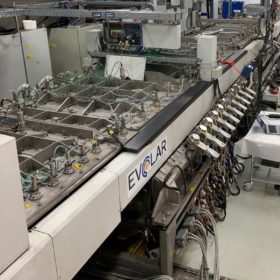
Evolar claims 25-year stability for perovskite cells
Evolar, a Swedish manufacturing startup, has put its perovskite cell technology through industry-standard accelerated reliability testing. It said its results show that the cells would likely remain stable for more than 25 years in the field.
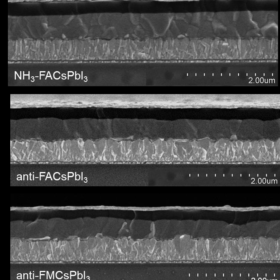
Healing defects with ammonia for a 23.21% efficient perovskite solar cell
Scientists in China demonstrated a process to “heal” defects in a perovskite film by using an ammonia treatment after the film is formed through a solvent process. Small solar cells made using these films achieved maximum efficiency of 23.21%, while a mini-module with a 14-square-centimeter active surface area reached 20.61%.
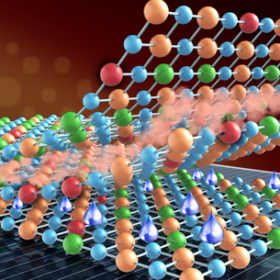
Surface engineering for an 18.6% efficient large-area inverted perovskite solar cell
Scientists in China worked with nickel-oxide as a charge transport layer in a perovskite solar cell, and were able to overcome several of the performance challenges associated with this material through careful surface engineering. Using this approach, the group fabricated an inverted perovskite solar cell measuring 156×156 mm that achieved 18.6% efficiency, along with ‘remarkable’ stability, according to its designers.
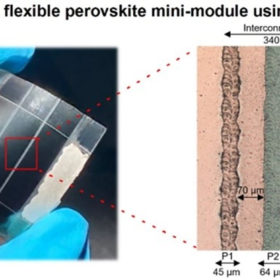
Four-terminal flexible perovskite-CIGS tandem mini-module with 18.4% efficiency
Swiss scientists have built a 4T tandem perovskite/CIGS mini-panel with a geometric fill factor of over 93%. It combines a 10.8%-efficient mini perovskite module and a 15.1%-efficient CIGS device.
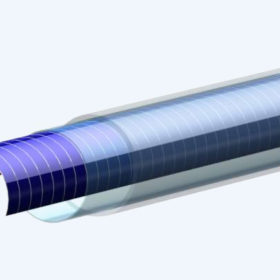
ZSW, Tubesolar achieve 14% efficiency for thin-film agrivoltaic solar tubes
TubeSolar and the Centre for Solar Energy and Hydrogen Research Baden-Württemberg have achieved a power conversion efficiency of 14% for a photovoltaic film based on perovskite.
