
Terahertz, microwave spectroscopy for more accurate PC cell assessments
A German research group has used spectroscopic methods based on terahertz or microwave radiation and has discovered that they might help with more precise assessments of the characteristics and performance of solar cells. Their proposed approach purportedly enables the evaluation of maximum possible efficiency levels for emerging materials such as perovskites in solar cells.
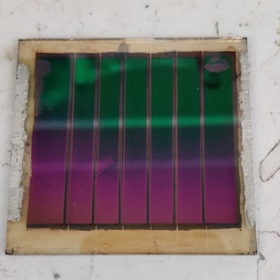
Semi-transparent perovskite solar cell with 13% efficiency, 27% transparency
Developed for applications in BIPV, vehicle-integrated solar and smart glasses, the solar cell was built with an ultra-thin, semi-transparent, triple-cation perovskite film and gold nanorods (Au NRs). The device achieved an open-circuit voltage of 1097.1mV, a short-circuit current of 17.11mA/cm2 and a fill factor of 73.12%.
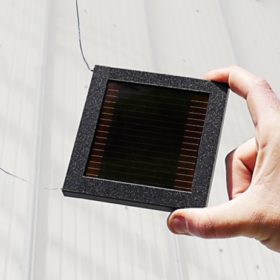
Mini perovskite solar module with 40 sq cm aperture area, 17% efficiency
The 19.2%-efficient perovskite cells used in the module rely on an electron layer based on tin oxide that was deposited via chemical bath deposition. This technique, according to the device’s creators, has made it possible to have a relatively small drop in efficiency from small cells to the 40cm2 module.
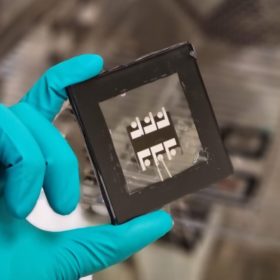
Damp heat–stable perovskite solar cell with 24.3% efficiency
Developed by scientists in Saudi Arabia, the perovskite cell was able to retain over 95% of its initial efficiency after 1,000 hours at damp-heat test conditions. The cell was fabricated with a substrate made of glass and indium tin oxide (ITO), 2D layers, a 3D perovskite layer, an electron-selective layer, a buffer layer based on bathocuproine (BCP), and silver metal contact.

Small-area, colored perovskite BIPV module with 13.9% efficiency
Through a conventional coloring technique for crystalline solar modules, scientists in Germany were able to manufacture a colorized small perovskite solar module in white marble optic displays that maintains up to 88.5% of the efficiency it had before coloring. The device was built with five cells interconnected in series and has a total area of 9cm2.

Making the case for perovskite quantum dots
Quantum dots, a type of semiconductor based on tiny nanometer sized particles, are a cause for excitement in many disciplines thanks to their unique electronic properties. In solar cell technology, quantum dots fabricated from perovskites could have several advantages over more commonly researched “bulk” perovskite materials, and researchers are beginning to take note of these. A group of scientists in China evaluated recent progress in perovskite quantum dot solar cells, noting both strong potential and a long way to go for this early-stage technology.
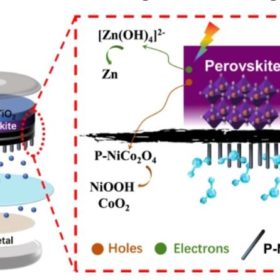
PV-powered rechargeable aqueous zinc battery
Conceived by scientists in China, the device combines an integrated carbon-based perovskite solar cell module with a rechargeable aqueous zinc metal cell. The proposed system achieved an overall efficiency of 6.4%, and a steady operation for more than 200 cycles with little performance degradation.
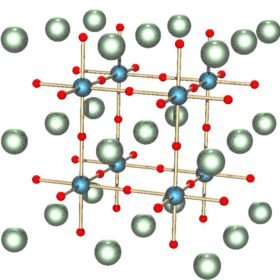
Perovskite solar cell with 24.18% efficiency via low-dimensional perovskitoids
Chinese scientists used perovskitoids as 1D and 0D capping layer materials for the cell’s perovskite layer. These materials enabled an effective and all-around passivation of the perovskite surfaces and grain boundaries, which prevents undesired Shockley-Read-Hall recombination and material degradation. The device achieved a power conversion efficiency of 24.18%, an open-circuit voltage of 1.151 V, a short-circuit current of 25.96 mA/cm2, and fill factor of 80.91%.
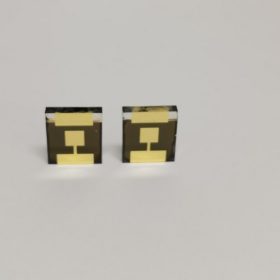
Perovskite solar cell with record-breaking fill factor of 86.6%
An international group of researchers has achieved the highest fill factor reported for perovskite cells of any size to date. The device was fabricated with a nitrogen-doped titanium oxide (TiOxNy) electron transport layer aimed at improving charge transport between the cell’s perovskite absorber and the electrodes.
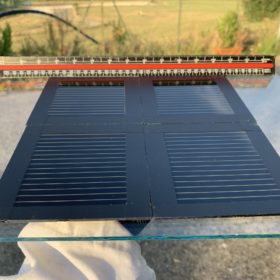
Perovskite solar module with 18.45% efficiency via co-solvent dilution strategy
The module was fabricated with methylammonium lead iodide (MAPbI3) perovskite solar cells via low-cost spin coating. The panel also achieved an open-circuit voltage of 16.07 V, a short-circuit current of 69.52 mA, and a fill factor of 75.35%.
